Wednesday, 5 June 2019

The Relationship Between SEO and Social: It’s Complicated … and Complimentary

Social media marketing and search engine optimization are often viewed as two disparate components of a holistic digital strategy. In some ways, they are distinct, but there is far more convergence and crossover than we’re often led to believe. I find that looking at one side through the lens of the other invariably helps me better understand the more ambiguous aspects of each. So today I thought I’d share this perspective, with a focus on how these tactical areas can work cohesively to strengthen your brand’s visibility and impact on the web.

Similarities Between Social and Search

Let’s begin by exploring some commonalities between social media networks and social engines. Both are massively popular internet entry points. Google processes 3.5 billion searches every day. Nearly the same number of people (3.48 billion) are active social media users. That’s roughly half the planet’s population. These numbers, in a nutshell, illustrate why digital marketers everywhere need to account for both search and social. They’re the first places most people go when they hop online. People use both to answer questions. We all know this is the primary purpose of search engines. Whether users are typing in a literal semantic question, or simply inputting keywords in hopes of finding information, they are trying to find answers and solve problems. Social media doesn’t necessarily present the same direct question-and-answer format, but we usually log on to satisfy some type of curiosity. (What are people talking about right now? What do my friends and connections have to say about recent events? Is this dress white and gold, or black and blue?) Both are critical brand touchpoints. Two of the easiest ways for any customer to vet a company are by: A) Pulling them up in a Google search, or B) Checking out their social media accounts. It’s pretty easy to tell based on a brand’s search rankings, SERP display, and site structure whether they have a sound digital strategy. The same is true of a quick glance at their Facebook, Twitter, and LinkedIn accounts. If it’s difficult to find your company through search or social — or if you give off a poor first impression on either front — that’s an immediate credibility-crusher.

Where Search and Social Can Work Together Strategically

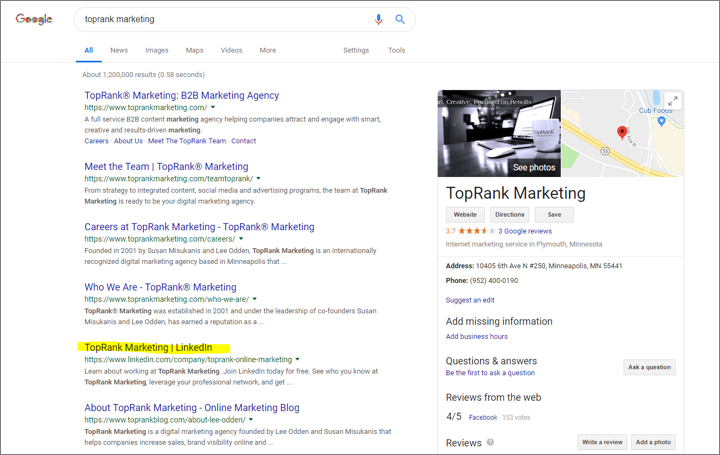
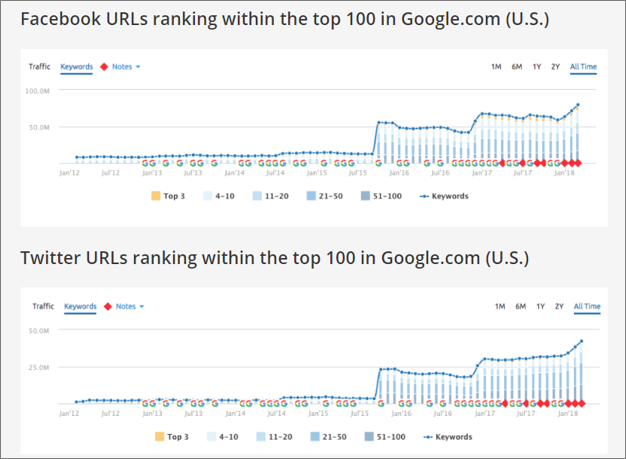
SEO and social media marketing are fundamentally different. There are job titles, and entire companies, dedicated specifically to each. But in an integrated digital marketing strategy, it’s important to recognize where these two facets intersect and complement one another. #1: Keyword Research and Application Keywords (and extensions thereof) form the backbone of a best-answer content strategy. The intel derived from these efforts can also be applied to social media marketing. As mentioned above, people use both these channels to answer questions. With a defined understanding of which search phrases and queries are pertinent to our audiences, we can better align the content we provide. This is true on social as well. When you use the right keywords (and, in this case, hashtags) more frequently in your posts, driving conversations and engagement around them, your brand will be more likely to show up on the feeds of people interested in them. In either instance, it comes down to the same foundational crux of almost any content strategy: What do your customers want to know, and how can you deliver it? #2: Social Content Can Show Up in Search Try entering your company’s name into a Google search. What’s the first result? Hopefully your website’s homepage. The second and third might also be pages from your own domain. But very frequently, the first third-party link will be your LinkedIn Page. (See the SERP for TopRank Marketing below as a typical example.) LinkedIn* is a particularly impactful platform in this regard; search engines crawl it, so incorporating savvy SEO tactics on your company’s LinkedIn Page can actually benefit your rankings. This hasn’t been quite as true for other networks, which were once almost invisible to Google, but research from HootSuite did find a dramatic increase in the appearance of Facebook and Twitter content in SERPS starting in late 2015: “Admittedly, the majority of social links within the SERPs appear for branded search terms, but this should not be discounted,” writes Simon Ensor at Search Engine Watch. “If we are in fact looking at marketing as a more holistic practice in the digital age, then we have to ensure that your branded search terms result in high click-through rates from search.” #3: Social Signals (Indirectly) Affect Search It’s been a hotly debated topic in the digital marketing world. Google has claimed for years that social signals are not a ranking factor. Yet, HootSuite’s experimentation found that “there appears to be a strong correlation between social activity and rankings.” Another study last year from Searchmetrics reached the same conclusion. We still don’t have complete clarity around this relationship, which would earn a Facebook status of “It’s complicated.” Although we don’t believe social signals directly impact search rankings, there is definitely a correlation, which is widely attributed to the byproducts of highly successful social content. As Sharon Hurley Hall puts it, “Social media may not be a ranking factor for Google, but it can amplify the ranking factors that Google DOES consider.” In other words, when a link to your content gains traction on social media, it tends to gain more general prominence: pageviews, backlinks, brand authority, etc. This, in turn, helps the page earn more visibility in the eyes of Google. The key is simply getting people to click through on those links, which brings us to the final point of convergence. #4: Compelling Clicks is Crucial Search engine optimization today isn’t so much about keyword-stuffing; Google is too smart to be gamed by it. The engine’s sole mission is to deliver the most satisfactory results for a given query, meaning it will weigh click-throughs and time on page more heavily than text arrangement. That’s why an irresistible headline and meta description are so vital to SERP success. This is also at the heart of social media marketing. In a sea of competing ephemeral content, you’ve really gotta stand out to capture someone’s attention and compel a click. (Especially since social media networks, unlike search engines, aren’t all that interested in sending users over to your website, so the algorithms will often work against you for outbound links.)   If you find a particular angle or message is especially resonant on social platforms (even if just for driving engagement, not clicks), you might consider adopting it for your meta descriptions to see if it improves CTRs, and vice versa.
Social and SEO: Two Keys to the Content Kingdom

These are separate tactical areas of digital marketing, but to treat them as completely independent would be a mistake. At TopRank Marketing, we view SEO and social media marketing as two complementary aspects of a fully integrated content marketing strategy, with numerous functional similarities and intersectional opportunities. Understanding how to maximize both in unison is instrumental to unleashing your brand’s full potential. Want to learn more about how different tactics can work together harmoniously in today’s digital strategies? Check out our recent post from Caitlin on The Intersection of SEO & Influencer Marketing: What B2B Marketers Need to Know. * Disclosure: LinkedIn is a TopRank Marketing client

The post The Relationship Between SEO and Social: It’s Complicated … and Complimentary appeared first on Online Marketing Blog - TopRank®.


Article Source: http://bathseoexpert.blogspot.com/2019/06/the-relationship-between-seo-and-social.html

Tuesday, 4 June 2019

Outsource SEO Services: What to Consider + Pros/Cons

SEO

Search Engine Optimization is not something that is just nice to have. It is a necessity. It is the backbone of profitability. It is the means by which businesses in all industries remain relevant in a competitive digital marketing world.

You know that you need SEO, but how do you go about developing and executing an SEO plan?

You can approach the SEO process in one of two ways. You can hire in-house staff to create an SEO strategy and focus on it full time, or you can outsource to a reputable SEO company that is staffed with veteran experts.

The question becomes, which path is best for your company? How can you ensure that you’re maximizing your SEO results while still staying within your budget?

Should You Outsource SEO?

To outsource or not to outsource. That is the first question that should be asked when embarking upon an SEO journey.

The short answer to that question is yes, you should most definitely be outsourcing SEO rather than hiring an in house specialist to oversee your campaign.

When you look at the dollars and cents of it, the act of bringing on full-time SEO staff is nonsensical with costs going through the roof.

White label SEO providers can do much more for your campaign for much less money. That’s partly because veteran SEO experts are not often seeking full-time work with a company. If they are, they’re making a lot of money to do so.

That’s because these SEO experts typically work with a team or on their own as a freelancer. This is a clear case of knowing one’s value in a crowded market. They are an integral part of an industry that will be worth almost $80 billion by 2020. Because of the demand for highly experienced SEO specialists, these individuals can often make a better living without having to work a 9 to 5 job.

That means that the SEO specialists you’re going to find that are willing to commit to a full-time schedule are likely new to the industry and just starting to make their name. While that’s all well and good, when it comes to something as important as your SEO score, you want to side with experience. With experience comes efficiency.

SEO veterans are highly skilled at streamlining the optimization process and producing results. At the end of the day, the results are all that matter.

When you hire an SEO outsourcing company, you’re often doing so for a mere fraction of the price you’d pay to hire someone full time. Remember, full-time staffers need full-time salary. To put that in perspective, the average full-time salary of an in-house SEO specialist is $72,808 per year.

That’s just the salary for the worker. It does not include the price of actually executing your SEO strategy. Companies usually require at least three full-time SEO specialists working together, so that $72,808 just became $218,424. These employees also require benefits and bonuses if you want to keep a skilled specialist from jumping ship into the arms of a competitor.

At the end of the day, you’re paying hundreds of thousands of dollars for your SEO, where a skilled firm or freelance specialists could give you better results for just a fraction of the cost. Even if you’re paying $15,000-$20,000 per year for SEO, that’s still only a small percentage of the cost you’d endure to have full-time staff.

Don’t pay more to receive less. That’s a simple rule of business that any amateur could tell you. When you outsource, you’re rolling the dice on a much more costly venture.

Outsourcing vs. In-House SEO

We’ve already determined that outsourcing is a far more cost-effective option as opposed to hiring full-time in-house staffers.

So, why then do people continue to hire full-time staff if it’s such a no brainer?

There are some benefits to having a full-time SEO team working in your office. Much like anything in life, there are both pros and cons to outsourcing your SEO.

Outsourcing Pros

Cheaper

As we’ve covered previously, it is far less expensive to outsource your SEO by a large margin. As a result, outsourcing holds a much greater opportunity for a return on investment. It’s a common rule of business that deliverables are greater when costs are lower.

Since the ultimate goal of all marketing efforts is to increase profitability, this is perhaps the biggest and most important issue to grace the pro section of this list.

More Experienced Professionals

The majority of full-time staffers you’re going to find are entry level rookies who do not yet have the experience to be considered by a large firm or to strike out on their own as a freelancer.

You want seasoned professionals working on your content because they understand Google and its algorithm better. Not only that, but they have fought in the SEO trenches for years and have a good handle on what it takes to succeed, and how to get you the best bang for your buck.

Larger Team Working on Your Site

When you hire full-time SEO staff, you’re looking at anywhere from one to three individuals working in your offices.

When you contract with an SEO firm you have an entire team of professionals working on your content. That includes experts in many different SEO fields. While the one to three full-time staff members would have to bring a slew of various skills together, when you work with a firm, you get a unique team of specialists, all working in various specialties.

You’ll have dedicated content writers, website designers, code specialists, metadata optimizers, graphic designers, strategists, social media specialists, and more. You get all of this hyper-efficiency for far less money.

Cons

Choosing the Right Firm

One of the most nerve-wracking choices when it comes to hiring an outsourced SEO firm is choosing the right firm. There are so many variables at stake, and SEO does not come cheap. You want to make sure that you’re picking the right company with the strongest track record.

You also want to make sure that they are on the up and up and practice white hat SEO.

White hat SEO is the term given to SEO practices that adhere to Google’s algorithm and don’t try to take shortcuts and game the system. The alternative is known as black hat SEO, and it is a series of “cheats” that work well in the short term but ultimately hurt your SEO ranking once Google realizes what’s going on.

Despite the dangers, there are many Black Hat SEO firms which offer reduced pricing for no results. These firms are more concerned with attracting a large volume of clients because of the high rate of turnover they receive.

SEO is a substantial investment, so it stands to reason that you’ll want to make the right choice the first time.

Divided Attention

When you’re working with an SEO firm, you’re going to have to live with the fact that you’re not their sole priority. Much like your SEO is only a part of your overall business operation, you’re only one of several clients that this firm is working on.

That’s where the allure of full-time SEO staffers come into play. You know that you have one to three individuals who are working in the marketing trenches on your site all day every day. That kind of attention is not something you’re going to find when outsourcing.

It’s important when hiring an SEO firm to understand how much time they’re devoting to you, what they are implementing throughout your content, and what the overall strategy is. Understanding all of this should be enough to soften your anxiety over just how much time and attention your money is buying from your chosen firm.

Transparency

When working with an SEO firm it is important that they are as transparent as possible when it comes to reporting. One of the main complaints a lot of businesses have regarding their outsourced SEO campaign is that sometimes it is hard to get their hands on status reports.

On top of that, you’re also often waiting to hear back when you have an inquiry. In this regard, it is hard to compete with the convenience of having full-time SEO specialists on payroll. When you want to know what’s going on with your campaign or you have a question, you can simply walk down the hall and speak to the specialist directly.

There is a lack of control when you’re working with an SEO firm, which is why it is so essential that you trust the firm that you hire. Also, make sure that they have detailed regular reporting for enhanced transparency.

How to Outsource SEO

If you’ve decided that outsourced SEO is for you, then there are certain steps you’ll want to take that ensure that you’re not falling into some common SEO traps.

For starters, find a number of reputable SEO firms and interview them. Don’t just go with the first firm that you speak with. It’s good to compare and contrast a few different ones and also do a cost analysis to determine exactly what you’re getting for your money.

Make sure that you ask a lot of questions about the SEO process of each firm, as there might be some red flags to watch out for.

That’s why it’s always a good idea to make sure that you have a working understanding of how SEO functions before you start talking with potential firms.

The main step you’ll want to take is to know the difference between white hat and black hat SEO tactics. Remember, if you fall victim to a black hat SEO firm, it will do more harm than good to your SEO, leaving you in a hole that will be difficult (but not impossible) to dig yourself out from.

Make sure you ask them about their link building strategy. Link building is one of the most important elements of SEO and it is something that you’ll want to make sure your potential firm understands and succeeds at. Essentially, they have to get highly ranked sites to link back to your page, marking you as an authority in your industry.

Ask them about their overall content strategy. What kind of content are they going to be writing? How will they change up the copy on your existing pages? Will they be writing blogs for you? All of this is incredibly important to know before you write a check, as content writing is essential for SEO success.

Make sure to ask about keyword research. You want to know that the company you’re working with does their homework in determining which keywords they’re out to rank for. The keywords that they target should be both high volume in search quality and relevant to your industry.

How often do they submit progress reports? Transparency is vital. You have to know how your campaign is doing. If you’re seeing no progress, you have a right to know why and take your business elsewhere. You should also know the process for when you have a question about your campaign. Do you have a dedicated account manager who you can reach out to?

Are they willing to explain their process? If they’re not, that’s a red flag. You want to make sure that they are on the up and up and are practicing white hat SEO. If they’re being cagey about what they’re doing, you might not want to do business with that particular firm.

Is your campaign custom? One of the biggest signs of black hat SEO is pre-packaged SEO campaigns. SEO is not a one size fits all process. Every campaign has to be custom fit to the company and the website that it is meant to help.

Do they have experience in your industry? All industries have different tactics and different levels of competition. If your SEO firm specializes in improving the sites of others in your industry, that’s a big plus.

Can you talk with past or current clients? Can you see case studies of success? Make sure that the firm you’re dealing with has a history of success. If they don’t want to show you examples or let you talk to other clients, that should be an immediate all-stop.

Conclusion

The best way to get the most bang for your SEO buck is to outsource the process to a reputable SEO firm or freelance operation.

Yes, you’ll be giving up some control over the process, but if you make your selection wisely you will invest far less and achieve far more than you would by entrusting in-house SEO staff members. Remember, full-time staffers need  full-time salary, benefits, and bonuses in order to do the same work that a dedicated team of seasoned professionals can do for a fraction of the cost.

The post Outsource SEO Services: What to Consider + Pros/Cons appeared first on HigherVisibility.


The post https://www.highervisibility.com/blog/outsource-seo-services/ appeared first on https://www.highervisibility.com

10 Smart Question Research Tools for B2B Marketers

The post 10 Smart Question Research Tools for B2B Marketers appeared first on Online Marketing Blog - TopRank®.


Article Source: http://bathseoexpert.blogspot.com/2019/06/10-smart-question-research-tools-for.html

Monday, 3 June 2019

Pump it Up: How to Maximize Your B2B Content Marketing Campaign Investments

Let’s talk shoes for a moment. Years ago, I purchased a stunning pair Jimmy Choo stiletto pumps; they were all the rage at that time. I’d been eyeing them for months and I convinced myself that this rather spendy investment would pay dividends in style and wearability. When my Choos made their public debut, I was showered with compliments on how gorgeous they were. I was feeling great. via GIPHY Of course, a few hours later a shooting pain in my Achilles tendon meant it was time to give them a rest, so I changed into tennis shoes. Today, those shoes are collecting dust in my closet. And every time I see them, I feel a mixture of regret (perhaps not my wisest investment after all) and longing to take them out for another spin (with the right insoles at a sitting event). B2B marketers are making huge investments in content this year, and that trend will only continue. From what we’re seeing across the industry, many marketers are investing in splashy content marketing campaigns. But like my Jimmy Choos, after the initial thrill and luster subsides, campaign content can start collecting dust at the back of the resource center and you may even wonder if it was worth the investment. The good news is, with the right insight and planning you can regret-proof you campaigns. Taking the time to ensure the right messaging, promotional strategy, and long-term opportunities can help you extend the life span and visibility of your campaigns and drive results that are meaningful to your team and brand. Here are five key considerations to help you do just that.

How to Maximize Your B2B Content Marketing Campaign Investment

#1 - Nail the hook.

This first step may be the trickiest, but it’s critical to build the foundation for a successful campaign. Creating a campaign hook that will inspire your target audience to engage, share, and talk about and remember your brand is both art and science. [bctt tweet="Creating a campaign hook that will inspire your target audience to engage, share, and talk about and remember your brand is both art and science. @Alexis5484 #B2BContentMarketing" username="toprank"] Let’s start with the science. In short, go with the data. Who is your ideal customer or prospect? Not just their job title and company size, but rather what problems are they trying to solve? Who do they trust? What are they interested in aside from doing their job? Where do they spend their time online? Leverage both quantitative and qualitative sources to bring this data together. Talk to your sales team or customer service reps since they are typically the most connected to your prospects and current customers. Engage in social media listening. Gather third party data. Perhaps consider creating your own data by designing and deploying a customer or industry survey. Then run the data you collect through the business lens. How do you solve your customers’ problems? What key features or benefits are deserving of more attention? What types of content (e.g. webinars, white papers, interactive infographics) can you create to garner the most attention and interest? And finally, how can you bring everything together under a creative umbrella for maximum resonance? This is where the art piece comes in. Tap into your best listeners, creative thinkers, and strategizers to finalize a theme and key messages that you believe will connect with and move your target audience. Now, this piece of advice can be key to testing the viability of your content hook both short- and long-term. Do some acid testing. Ask your network for their initial thoughts or run a few A/B tests on social media to see if your hook is resonating. You’re not just looking for thumbs up. You’re looking for messaging that is memorable, creates brand affinity, and propels the user to take action.

#2 - Make promotion part of the planning process so you’re ready for launch day and beyond.

Your team has put a lot of effort into building your campaign. But far too often, promotion is an afterthought rather than an integral part of the planning and strategy process. This ensures integration from the beginning, minimizes stress as you draw closer to launch day, and allows you to think more globally about how you can promote or repurpose into the future. [bctt tweet="Content promotion can’t be effective if it’s an afterthought. Your best practice would be to make promotion part of content planning. - @leeodden" username="toprank"] As you draw closer to launch, create a promotional timeline that includes your tactical mix and content types. Ideally, that timeline will be at least three months in length. This will help you prevent a campaign from flaming out after two weeks of heavy promotion. Your promotional timeline and plan could include:
  • Adding crosslinks and/or banner CTAs across your website or blog
  • Emails to customers and prospects
  • Social media messages, images, and video across major channels
  • A paid social targeting plan
  • Press releases or other third-party editorial
  • Repurposing plans (which we’ll get to in the next section)
Of course, when launch day arrives, the real work begins. Day 1 promotion is important to gaining campaign buzz, so plan to get all your promotion engines firing. But perhaps the most important piece of building out that promotional timeline is creating a cadence; tactics can be used beyond Day 1 or Week 1. (e.g. Just because you sent an email or press release on Day 1, doesn’t mean you can’t again on Day 7, Day 14, or Day 30.) For more insight on designing your promotional timeline, check out these 50 content promotion tactics.

#3 - Optimize … and repromote.

Since you did so much research and planning upfront, hopefully your message is resonating and you’re seeing great results one, two, three, or even four weeks out. But whether you’re meeting, exceeding, or falling short of your expectations, post-launch is the time to really maximize your investment. At launch, establish a regular check-in cadence with your team to review results and discuss campaign optimization opportunities. This is not the time to sit back and just watch the results roll in. You can start optimizing campaign performance on Day 1. There are two key areas to focus on during your check-ins:
  • Reach: Are you reaching your goals in terms of visibility? If not, you may need to look at additional channels (e.g. third party editorial) or adjust your paid investment (if you haven’t already). In addition, look at what channels are driving the most visibility and put more investment there.
  • Engagement: This is a time to review what messages, visuals, and channels are driving the most people to take action. If certain messaging isn’t working, swap it out. Take a look at the bounce rate, conversion rate, and time spent on your landing page. This is usually a prime place to make adjustments.
Optimization will help you throughout the course of the campaign to learn from what is working and make adjustments to ensure more reach and engagement (and less regret) throughout.

#4 - Repurpose … and repromote.

Every brand is sitting on a dust-collecting gold mine of content. Whether you’re launching a brand new campaign or you’re trying to resurrect (or reimagine) one from a months or years past, this consideration has unending relevance and applications. Also, if the above mentioned recommendation to create a three-month promotion production timeline felt too long, you may not have been thinking about repurposing opportunities. Here are a couple repurposing scenarios for your consideration: Repurpose to extend the life of your campaign. In this scenario you’re repurposing elements of an active campaign to drive back to your primary content hub. An easy way to repurpose content is to change up the format type. For example, pull out nuggets from a text based eBook and create a video for social media or YouTube to drive back to the original asset. If your content was audio or video, pull quotes and create a series of text based blogs driving back to the main asset. A new infographic, motion graphic, or blog content is a good reason to re-promote, remind your existing audience, and reach new prospects. Repurpose to create your next campaign. Even after the lifespan of a campaign is mostly over, that campaign investment can absolutely be leveraged for a future campaign. You can create an entirely new campaigns by bringing together previous content from other campaigns, blog posts, and influencer contributions. It can also work really well to freshen up an evergreen piece and re-release with new information. Here’s a recent example from *LinkedIn. The Sophisticated Marketer’s Guide to LinkedIn was a cornerstone campaign a few years back, and a helpful asset that had long-term appeal. And in honor of its fifth anniversary, the content and design was refreshed, re-released, and repromoted. LinkedIn Relaunches The Sophisticated Marketers' Guide Bonus tip: In order to be really effective at repurposing content, it really helps to have some kind of searchable repository of all the content that has been created organized by topic. Your website isn’t always the most reliable or complete source of content created. Read: A Tasty, Strategic Addition to the Content Marketing Table: ‘Repurposed Content Cobbler’

#5 - Integrate your B2B content marketing campaigns with your always-on strategy.

If you really want to maximize your B2B content marketing campaigns, you have to think long-term. Campaigns work hand-in-hand with your ongoing, always-on marketing efforts. Ultimately, your marketing efforts aim to fill the funnel, foster brand affinity, and achieve business ROI. If you design campaigns that fit within your core objectives, strategy, and marketing pillars, then they’ll always be a make-sense investment. In addition, integrating you campaigns within your always-on strategy can help you enhance your nurturing capabilities as they relate to your customers, prospects, and target audience, as well as influencers, by creating an interesting, steady drumbeat of content. It also makes repurposing easier and helps extend and keep conversations top-of-mind.

Pump Your B2B Content Marketing Campaigns Up

Flashy, attention-grabbing campaigns can be great investments. They can drive valuable spikes in traffic, engagement, or conversions, as well as help you target specific audiences or verticals. However, without an eye toward the long-term, campaigns often end up like my beautiful Jimmy Choo pumps: A wasted investment that’s collecting dust. By spending time upfront to thoughtfully identify your creative hook and robust, longer-than-a-few-weeks promotional strategy, you can continue to promote and optimize your campaign content for maximum impact and ROI. Are you notching some serious big wins on a recent campaign? How do you keep that momentum going? How do you apply your learnings to what comes next? Check out my post on driving continuous content marketing improvement. *Disclosure: LinkedIn is a TopRank Marketing client.

The post Pump it Up: How to Maximize Your B2B Content Marketing Campaign Investments appeared first on Online Marketing Blog - TopRank®.


Article Source: http://bathseoexpert.blogspot.com/2019/06/pump-it-up-how-to-maximize-your-b2b.html

Thursday, 30 May 2019

Maintaining Your Focus: What B2B Marketers Can Learn From My Home Improvement Snafu

B2B marketing lessons from home improvement (1)

B2B marketing lessons from home improvement (1) The sweet smell of fresh cedar is wafting in the breeze around my homestead this week—along with hint of marketing inspiration. Let me explain …

Best-Laid Plans

To take advantage of a long holiday weekend and a string of dry-weather days, my darling husband and I embarked on a “small” home improvement project: Sanding and staining our recently built 16-by-16 deck—plus an intricate one-story staircase. She was such a beauty following her construction last fall. But as is tradition, a delightfully heinous Minnesota winter set in. When spring arrived, she looked weary and weathered. For months, we prepared to offer ourselves up to the cause once warmer weather came. And with the help of how-to YouTube videos and a lot of strategic Googling, our confidence and can-do attitudes were on the rise. When that fateful weekend arrived, we weren’t so naïve to think this project would be easy—it would take time, attention to detail, teamwork, and a bit of strategy to do it right. We didn’t fancy ourselves skilled craftsmen, rather capable apprentices who knew how to wield a sander and paint brush. We were ready. But in accordance with the prophecy of best-laid plans, things quickly went awry. From seemingly unavoidable inefficiencies to tool malfunctions to weather miscalculations, what started as a one-day-tops project has officially spiraled into a multiple weekend ordeal. We were worn down and frustrated, not knowing exactly what to do at times. Do you see what I’m getting at, B2B marketers?

Facing Failure

The frustration and disappointment that comes with falling down on what you thought was a well-planned or strategically innovative initiative is something every B2B marketer has had to face. Maybe you’ve gotten buy-in on an influencer marketing initiative and determined a few weeks in that you don’t have the bandwidth, niche expertise, tools, or timeline to execute effectively. Perhaps you’ve invested a sizeable portion of your budget in a marketing automation tool only to discover you lack the integrations, process documentation, or internal resources to get it fully off the ground. Or more simply, a tried-and-true tactic isn’t driving the results it used to—and you may not even know why. Regardless of the situation, the anxiety and emotion you feel can make it incredibly difficult to gain the perspective you need to quickly pivot your approach. So, how do you accept what’s happened and move ahead with ambition and confidence?

Finding Focus

When small or seemingly insurmountable challenges arise, success is directly tied to our ability to keep our eye on the prize: The goals or outcomes we hope to achieve. With our objectives in focus, we can rely on our smarts and experience (and perhaps even a little insight and help from a agency trusted partner) to guide the most effective tactics that come next. Frankly, after just one hour of sanding, we knew it was going to get ugly if we didn’t adapt to the reality of the situation. That said, it took us a full three hours to fully accept our fate, and refine our approach and reset our expectations. Through repeated equipment failures, four extra trips to two different hardware stores, and now being the proud owners of four sanders of varying sizes, the sanding is complete and the staining is planned for the next string of sunny days. Here she is after 20 hours of sanding—a near spitting image of her original glory last fall: So, remember this B2B marketers: You have a lot on your plate and things don't always go as planned. From creating relevant, engaging content on unsexy subject matter to contending with increasing competition, buyer distrust, and long sales cycles, B2B marketing is no cake walk—it’s an endless work in progress. However, with a steadfast focus on your end-goal, there’s no such thing as failure, just another opportunity to get it right. [bctt tweet="With a steadfast focus on your end-goal, there’s no such thing as failure, just another opportunity to get it right. @CaitlinMBurgess #B2BMarketing" username="toprank"] Looking for more crafty inspiration? Check out our post on three “real-life” tools that need to be staples in your B2B content marketing toolbox.

The post Maintaining Your Focus: What B2B Marketers Can Learn From My Home Improvement Snafu appeared first on Online Marketing Blog - TopRank®.


Article Source: http://bathseoexpert.blogspot.com/2019/05/maintaining-your-focus-what-b2b.html

Wednesday, 29 May 2019

SEO Trends 2019: The Latest & Most Current Tactics that Actually Work

SEO

SEO is more than a marketing fad. It is a necessity for online exposure in 2019. It is through search engine optimization that you stay competitive within your industry. There is a constant struggle for SEO supremacy. But the means by which you reach the peak of the search engine mountain varies year by year.

If you managed to claim first page exposure in the SERPS, you can’t just rest on your laurels and expect to get by. One change to Google’s search algorithm could cast you down into obscurity overnight.

And make no mistake about it, Google’s algorithm changes often, and in extreme ways (think last year’s mobile-first index or previously RankBrain). If you’re not up to date on how it continues to evolve, you risk being left in the dust.

SEO is not something you just do one time and then stop. It is a living, breathing, evolving creature that must be constantly maintained. SEO in 2019 looks far different than SEO looked in 2009.

So, what are the current trends in SEO that are achieving results in 2019? Read on to find out!

User Intent

One of the keys to any SEO strategy in 2019 is to have a strong understanding of user intent. By that I mean you have to know what your audience is looking for.

For starters, you need to understand simple things like what platform your core audience is looking to use. Are they more desktop oriented? Do they like mobile platforms like cell phones and tablets? Would they prefer a regular website, accessed through a web browser, or are they looking for standalone applications?

What about the kind of content they want to see? Do they want text? Audio? Video? The way in which you primarily communicate with your core audience should match up to their wants and needs.

Likewise, understanding what your audience expects to see when they search is important. Specifically, you have to understand what questions they are most likely to ask platforms like Google.

You need to provide the answers to their questions in a way that is simple, effective, and relatable to the experience that they prefer.

Audience identity and intent is vital to your success, regardless of SEO. Even perfectly optimized content is useless when it is designed with the wrong audience in mind. You might get a lot of eyes on your site, but none of them will convert to profitable ventures unless you customize the user experience to them.

On that front, Google wants your site to enhance the user journey. After all, when Google ranks your site highly on its platform it is essentially giving you its seal of approval and signing off on your content. Google is naming you an authority in your field, and they don’t do that lightly.

This should be at the forefront of your mind, both when it comes to designing your site as well as creating quality content. You have to keep the intent of the end user in mind as you write.

Another factor to keep in mind is the end user’s place in the sales funnel. It is your job to meet them where they are, not where you think they should be.

To that end, SEO is no longer all about matching keyword phrases. It has evolved and become more about answering questions and covering that topic completely.

That’s not to say that keywords are dead. Far from it!

Keyword research has evolved. That means 2019 marketers have to pay careful attention to search engine results pages to see how similar websites are ranking for the same keywords that you’re targeting.

Optimize Beyond Google

Since the dawn of SEO, everything has been all about the all mighty Google. That has changed in recent years. Google search continues to dominate the market, but it is not the only game in town.

No, we’re not talking about other search engines. Google has that on lockdown. While it’s nice to optimize for Bing and Yahoo, they have such a small percentage of the market, that they are not really a major factor.

Other platforms like Amazon and Apple’s App Store are becoming more important as users continue to rely more and more on e-commerce for their shopping needs.

If you’re an e-commerce business, you need to be focusing on Amazon. It gets the lion’s share of e-commerce traffic and, as we said in the last section, it is important to meet people where they are searching.

To that end, Amazon SEO and App searches are becoming far more prevalent. And optimizing content for those platforms is a whole other animal.

Amazon has its own proprietary algorithm called A9, and it takes a lot of various information into account, including a more heavy focus on conversions.

You also have to optimize your content based on the devices that your audience is using. That means optimizing for mobile devices, home assistants or audio devices, which are becoming increasingly popular.

How popular? Smart speaker use grew by 200% in the third quarter of 2018. This trend is expected to continue into 2022, where it is estimated that 55% of households will include some kind of smart speaker device. That is a 42% increase from today.

Voice search is rising fast, with customers now expecting answers the moment they ask them. That is part of the major shift in customer intent from search results to getting answers. As such, search queries are becoming more conversational in tone and have to be optimized that way.

Apply Structured Data

One of the key elements of modern SEO is to include structured data in the code of your website. That is because the search engine industry has begun to rely more on artificial intelligence. As the need for AI increases, so too does the need for structured data.

Structured data is code that speaks directly to search engines, showcasing who you are, what you do, and why you deserve to be ranked high. It is the key to moving forward with artificial intelligence.

Structured data makes it easier for artificial intelligence to take in all of your content and determine how your site works.

The faster the processing, the better it is.

Structured data is the key to determining the contextual relationships between the behaviors of your customers and the topics that they are searching for.

Structured data also gives search engines specific information that allows it to understand content that is more based on topical information and customer support.

Content is (Still) King

Content has always been the king when it comes to SEO. After all, optimized content is the name of the game. This is one thing that has not changed whatsoever.

In fact, optimized content has actually gotten even more important!

In a 2018 update to Google’s search algorithm, we saw a more intense focus given to the quality of a site’s content. Because of that, you want to provide depth in your quality, as opposed to just hamfistedly stuffing keywords into paragraphs.

Google placed a lot of attention on this specific issue in 2018, so it stands to reason that 2019 will be no different.

Ideally, you want to create the kind of high-quality content that will inspire links. One of the main ranking factors that go into determining SEO placement is the presence of backlinks. These are links that connect to your site placed on high value and relevant websites which Google has ranked highly. Consider it a letter of recommendation to Google. It is a respected site telling Google that it vouches for your information and your authority on the subject.

The best way to inspire such confidence on the part of other sites is to make sure that your content is stellar.

Your content needs to address and solve a relevant problem as opposed to being a random buffet of mashed together keywords. The content needs to motivate, move, and connect with your specific audience. Remember who you are writing for.

Focus on the Technical Aspects of SEO

Technical SEO has become much more important as websites continue to evolve. Websites are becoming far more advanced, and the technical functions of those sites are in turn becoming much more important.

For starters, Google rewards sites for speed. The faster your response time, the better impression you will make on the search engines. That means you shouldn’t sacrifice page speed for the sake of your site’s advanced features. One of the best ways to ensure that your SEO score won’t suffer is to make the site simpler and faster to impress Google.

Machine Learning

A huge feather in the cap of your SEO score would be a focus on machine learning. That’s because machine learning is becoming more common as artificial intelligence systems are rising in popularity.

Machine learning is already a powerful tool, and it hasn’t yet achieved the true limits of its power. As such, machine learning is set to be a major player in 2019 and beyond.

Furthermore, employing machine learning platforms throughout your digital marketing plan can play a big part in answering the question of search intent. Machine learning can be used to develop SEO content by helping you to better understand your core demographic.

Through machine learning, businesses can actually see where their approach succeeds and fails. It can determine where there are holes in your approach much more efficiently than human analysis.

Machine learning systems can accurately study your audience as a whole and determine not only what they are looking for but how you can best provide that to them.

Aim for Search Engine Results Page Features

Search engine results pages are the arena in which SEO campaigns succeed or fail. As such, you should study the layout of search engine results pages and try to ensure that your content is featured above others. One of the best ways to do that is to rank as a featured snippet.

Featured snippets are select Google results that display above the organic search results. It is a snippet of your content that is tossed up as the answer to the question asked by a user.

Features snippets should be highly sought after as they are great for attracting new traffic. They are found in 12.29% of all search queries and siphon off a percentage of the clicks from the number one position.

To illustrate that point, search results with no featured snippet in place see the number one spot getting 26% of all clicks that come in for that search. When there is a snippet, the number one slotted result only gets 19.6% of the clicks.

Answer boxes and recipes are also big traffic items. Typically answer boxes will appear in a light gray box above the organic results, in an attempt to directly answer long-tail questions. Recipes are found for food-related searches and also appear prominently on a search engine results page.

Sometimes these boxes are known as “zero position” as they appear even before the first organic result.

They should be respected and coveted because of the exposure that comes with them. SEO is all about receiving exposure, and exposure is driven by visibility within the search engine results page.

In Conclusion

Familiarize yourself with these growing trends to ensure that your SEO efforts are not unseated in 2019 and the new years ahead. By continuing to monitor the industry and note changes to search algorithms, you will protect your SEO campaigns and maintain your well-earned spot on top.

The post SEO Trends 2019: The Latest & Most Current Tactics that Actually Work appeared first on HigherVisibility.


The post https://www.highervisibility.com/blog/seo-trends/ appeared first on https://www.highervisibility.com