Thursday, 13 June 2019

B2B Demand Gen: The Next Evolution of 5 Tried-And-True Tactics

New Demand Gen Tactics B2B demand gen used to be easier than B2C. Because, let’s face it, so much B2B marketing was deadly boring. A cool concept, a little creative design, or a dash of humor were like water in the desert. Now, though, it’s the norm for B2B marketing to be every bit as visually and emotionally compelling as B2C. Suddenly we’re selling water by a lake, not a desert. There’s no shortage of cool content. Audiences expect more, and marketers (including your competitors) are keeping up with demand. So it’s time to take B2B demand gen to the next level.

B2B Demand Gen Tactics: The Next Evolution

What follows are some logical upgrades for some of your favorite time-tested tactics. That’s not to say, of course, that you should stop doing things that are already working. But it’s worth testing these evolutions out to see what works for your target audience.

#1: Influencer Marketing to Influence 2.0

B2B influencer marketing has matured a great deal in the past few years. Marketers are looking at topically-aligned influencers with smaller but more relevant networks, and looking to create partnerships rather than paying for endorsements. But we still have room for improvement. Influence 2.0 seeks to build an always-on, continual process of influencer nurturing, community building, and content co-creation. Instead of individual campaigns, it’s about sustaining relationships, introducing influencers to each other, and continually producing content together. [bctt tweet="For any kind of content a business creates and publishes to the world, there is an opportunity for collaboration with credible voices that have active networks interested in what those voices have to say. - @leeodden" username="toprank"] When you have a sustainable community of influencers, you can integrate influencer content into virtually every part of your marketing efforts. That’s why I put it first on this list — you can add influencers to all of the following tactics for better amplification and engagement.

#2: eBooks to Interactive Content

The classic PDF-format, static eBook is a B2B content marketing staple. Over the last decade, we’ve seen eBooks becoming more dynamic, more visually compelling, more creative and fun. Like, say, this one from our client Pantheon. So I’m not here to put down eBooks. But as an agency, we’re starting to lean into more interactive content, and seeing some stellar results. Interaction can be as simple as adding animation or multimedia content to a slideshow or eBook. Or you can go more complex, ditching that page-based form factor completely. Some of our best-performing agency work recently is vertically-scrolling, animated, and interactive. The core content is much the same as a conventional eBook, but it’s much more likely to earn attention.
Click Here to see the Break Free from Boring B2B Guide in Full Screen Mode

#3: Gated Big Assets to Gated Bonus Content

The time-honored tradition in B2B marketing is that you gate your most valuable stuff. Then you give away smaller bits of content to entice people to fill out your lead gen form. Which means a small percentage of people actually see the asset you spent the most time and effort on. It’s a tactic that can still work, but it’s worth trying the other way around, too. Note that none of the assets I linked in the last section are gated. We put a ton of research, creativity and effort into making each one. And then we and our clients used them for demand gen. We found that influencers were more likely to amplify an ungated asset, and that meant more people got to see the thing than if it were gated. When you put an ungated big asset out there, make sure to include an opportunity for people to convert, of course. We have found that a simple but useful downloadable, like a checklist or worksheet, works well to convert traffic from our big ungated assets. Read: To Gate or Not to Gate? Answers to an Age-Old Digital Marketing Question

#4: Everyday Blogging to Everyday Multimedia

The blog post has been the “atomic unit” of content marketing for a long time now, and it’s easy to see why. All you need to make a blog post is a computer and a WordPress site (though hopefully you also have a strategy, research time, and an editorial calendar). The barrier to entry is low and the potential for engagement is good. We’re finally seeing the democratization of video and audio content, however. It’s now potentially easier to create simple video or record a podcast than to write a substantial blog post. Video content can be embedded on social sites (more on that in the next section), and podcasts can be syndicated in dozens of directories. There’s a ton of demand gen potential in trading some of your blogging time for multimedia time. [bctt tweet="There’s a ton of #demandgen potential in trading some of your blogging time for multimedia time. @NiteWrites" username="toprank"]

#5: Social Links to Social First

Social media has been a demand gen staple for marketers since the early days of Facebook and Twitter. The time-honored tactic for social media is to post links to blog content or gated assets, encouraging people off of the platform and onto your own real estate. The problem is that social media sites don’t want people clicking away from their feeds. They want posts that generate engagement while keeping people firmly inside the walled garden. The sites’ algorithms will reward posts that don’t link out, while actively limiting the reach for posts with external links. We have been exploring a “social first” model for demand gen on social media, and the early results are promising. With a handful of clients, we're testing long-form content on LinkedIn, with the goal of boosting engagement right in the news feed. These posts are outperforming their average for comments and reactions, and are driving new followers for the Showcase Page, too. In other words, instead of using social media to drive traffic to your content, bring your content to social media.

Practice Next Gen Demand Gen

Which demand gen tactics work best? The answer will vary depending on your industry and audience, of course. But in general, our time-tested tactics could stand to be augmented and upgraded. Marketers who can get ahead of changing audience preferences will stand a far better shot at earning and keeping attention. Looking for opportunities to evolve your content promotional strategies? Take a peek at these underutilized content promotion channels.

The post B2B Demand Gen: The Next Evolution of 5 Tried-And-True Tactics appeared first on Online Marketing Blog - TopRank®.


Article Source: http://bathseoexpert.blogspot.com/2019/06/b2b-demand-gen-next-evolution-of-5.html

Tuesday, 11 June 2019

When & Why Net-New Content Creation Makes Sense—And When It Doesn’t

When New Content Creation Makes Sense

When New Content Creation Makes Sense 1996: The year content was named “king” in a burgeoning digital world. 2001: The year "content marketing" was officially coined and the modern content revolution began. 130 trillion and counting: The number of webpages currently indexed by Google. One zillion infinities: The number of pieces of content you stand to create during your B2B content marketing career. Zero: Perhaps the number of times you've asked yourself, “Do I really need to create a new piece of content?” If the last one strikes a little too close to home, we're not passing judgement — rather we're reminding you that you don’t always have to start from scratch. Consistent quality content creation comes with the territory; it’s an integral part of your B2B content marketing strategy. Content is how we reach, help, and educate our buyer audience. Furthermore, as buyers and buyer committees evolve, there’s always going to be a place for net-new creation. But many times, refreshing, repurposing, and optimizing can play a major role in the creation process, and sometimes you may just need to stand down.

Do You Really Need a New Piece of Content? Yes. No. Maybe So.

If you need to fill your editorial calendar…

Stop, collaborate, and listen. via GIPHY While no content marketer wants to admit they’ve created content for the sake of filling a spot on the editorial calendar, it happens all the time. Again, no judgement here. But we had to call it out. So, before you feel tempted to fill a calendar opening, consider channeling that time and effort into more research or an audit. For example, performing an SEO and content audit, a task that aims to assess the current state of your internal content ecosystem as well as external variables, can unearth unique opportunities that can fill your editorial calendar with net-new and refresh ideas.

If a relevant and previously uncovered topic, trend, or paint point presents itself…

Go for it. Your goal is to be the best answer for your audience. In order for your content ecosystem to thrive, you have to have your basics covered (i.e. product explainers or resource guides) and within reach for your audience. If you see gaps in those core areas, you need to fill them. But as buyers become more empowered and voice search and assistants gain increasing popularity, they’re regularly uncovering new problems they need solved and more pointed questions they need answered. This means regular review of who your audience is and the questions they’re asking is more important than ever. You should be regularly leveraging website analytics, Google Search Console, question analyzer tools, and the list goes on to unearth and inform content creation opportunities.

If no one’s talking about those relevant topics, trends, or pain points ...

Then you should absolutely go for it. Remember the legendary wisdom of Ricky Bobby’s pop: “If you ain’t first, you’re last.” via GIPHY It’s rare that you’re given the opportunity to create thought leadership and demand around something that’s new to your internal and external content ecosystem. Of course, that window of opportunity won’t be open for long. HubSpot’s Brian Halligan famously did this with the term “inbound marketing” — a term that every marketing department now accepts, understands, and uses. One note of caution, however: Creating demand around an original idea or rising topic requires vigilance, creativity, and integration with a range of content marketing tactics (i.e. influencers, paid and organic social media, email marketing, etc.) SEO is a long-term factor, but in the short-term, don’t let low search volumes deter you.

And if everyone’s talking about those relevant topics, trends, or pain points ...

Proceed with cautious ambition. Tackling a highly-publicized or popular topic is worth it when you’re confident in your ability to provide new and/or better insight and expertise than your direct and indirect competition. Becoming the best answer for a topic, trend, or niche is both art and science: You need the right expertise and the topic needs to be relevant to your audience. You need credibility and authenticity. And it all needs to be backed by relevant data insights.

If you think that your existing content is too old to be relevant ...

Table net-new content creation … for now. Instead of throwing out or forgetting about the old, consider giving it a revamp. Refreshing content has numerous benefits — from sending positive SEO “freshness” signals to search engines to boosting your efficiency and productivity. Analyze the performance of that blog post, downloadable asset, or web page to understand traffic, rankings, engagement, and so on. Then couple those findings with first-hand research on other similar content in the external ecosystem. If you determine your existing content has potential for a second life, add new content, insight, resources, and so on. You can then republish and repromote, and continue to optimize. If you determine it’s a lost cause, recreate and redirect the old content to pass any remaining authority onto your new content.

If you’re trying to reach a new audience…

Net-new or net-old, this one’s a personal call. Talk of content personalization has reached a fever pitch. That means B2B marketers have more reason and opportunity than ever to create tailored content for new or specific audience. Identifying a new audience segment fills your content pipeline with additional repurposing opportunities — or it can be the repurposing opportunity. Have you seen the rise of a new purchasing stakeholder group? Develop specialized content just for them. Do you have targeted content on financial management for healthcare companies? Repurpose and personalize your content for your legal or technology verticals.

If your content will target a keyword you already own search real estate for ...

Press pause. Target keywords that are already mapped to other pages — especially your service pages — could hurt your search footprint and cannibalize traffic from other content. The good news is that your concept can be saved and utilized in a different way in the future. However, that’s not to say your content concept shouldn’t be saved and utilized for the future. For example, you could evolve your concept to target a longer-tail query that’s related to your original idea. And using the hub and spoke content model, you can build out your authority around the overarching topic and implement strategic cross-linking to turn it into a smart SEO play. Long-tail keyword phrases also allow you to more closely match your audience’s search intent, creating the potential for rising in the (search) ranks.

If new content runs the risk of being duplicative…

Stop. Do not pass go. Do not collect $200. Duplicative content is a no-no, and has been and will be forever. via GIPHY

If you want to launch a new content type ...

You have the green light. Introducing new content types diversifies how your audience can discover, interact with, and digest your content. New content types also cater to changing audience preferences for content consumption. Maybe you want to evolve several statistical roundups into a single infographic. Or perhaps you want to enable your audience to solve problems and find answers to their questions through an interactive quiz. But a quick note here: This may also be an opportunity for refreshing, repurposing, or optimizing existing content. So, be intentional. Read: B2B Brands Go Bold: 7 Great Examples of Interactive B2B Content

Key Word: New

Net-new content creation should always be top of mind for content marketers. You should always be thinking about how you can inform, engage, and inspire your audience to action. But new content needs to provide new value — not fill an editorial gap. And not all new content needs to be built from scratch, rather there are several opportunities to refresh, repurpose, republish, and optimize for performance. If you’re ever in doubt on what to do, we hope this piece lends some perspective. But if doubt persists, remember this tidbit from the incomparable Ann Handley, Chief Content Officer at MarketingProfs: “We don’t need more content. We need better content!” [bctt tweet="We don’t need more content. We need better content! @annhandley of @MarketingProfs" username="toprank"] Want to identify areas where your content can be better? Use these Best Answer Content Examples to see how your internal and external content ecosystem measures up.

The post When & Why Net-New Content Creation Makes Sense—And When It Doesn’t appeared first on Online Marketing Blog - TopRank®.


Article Source: http://bathseoexpert.blogspot.com/2019/06/when-why-net-new-content-creation-makes.html

Monday, 10 June 2019

Ally or Adversary? How Our Marketing Fears Can Be Wielded for Good

Now Fear This: Kicking Fear to the Marketing Curb

Now Fear This: Kicking Fear to the Marketing Curb B2B marketers are a special breed: We’re relentlessly self-improving. We look to our industry peers and thought leaders for wisdom. We scour data for opportunities and insight. We keep tabs on rising trends and emerging tools. We tirelessly strive to adapt our strategies to the evolving needs of our customers and prospects. Without a doubt, we’re ambitious. But despite that ambition, we’re only human. Fear can easily creep in—which can become a helpful tool or a crippling bad habit.

Fear Itself

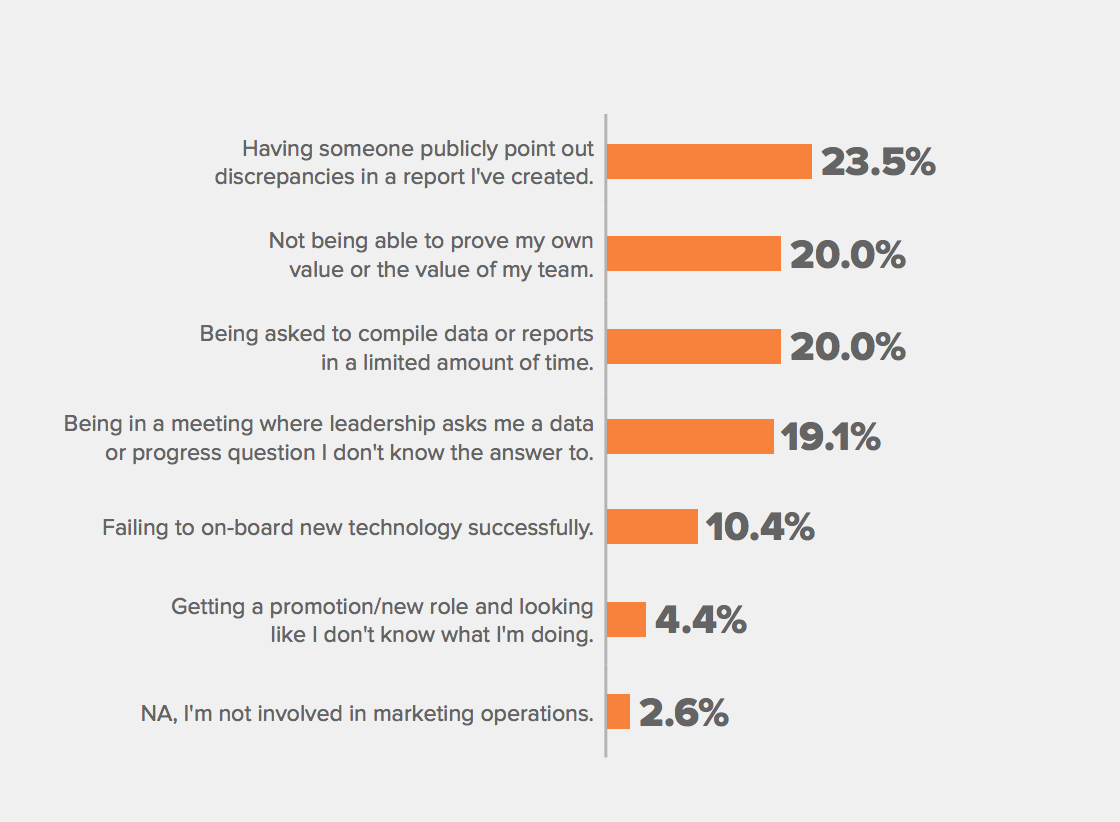
Fear is the most natural human emotion in my opinion. The presence of fear in our marketing minds not only signals self- and spatial-awareness, but also benevolence. We deeply care about what we do and who (i.e. our brands, co-workers, and buyers) we serve, and we want to do our absolute best to drive results and offer solutions. With the right focus, fear can be an unexpected ally. But the problem is that fear lurks everywhere. A recent survey by Workfront and MarTech Today specifically asked marketing operations leaders about their top fears. The largest percentage (nearly a quarter of respondents) said having someone publically point out in a discrepancy in a report as a top fear. Coming in second with 20% of the vote was fear of not being able to prove their own or their team’s value. I'd wager that an expanded survey would likely reveal other terrifying scenarios such as discussing poor results, getting budget or strategic buy-in, trying and potentially failing at a new content type—and the list goes on. Workfront Survey Now, while the report overall aimed to provide insight into the workplace challenges marketers face as data and technology drive change, this particular section provides a glimpse into how fear can manifest on both grand and granular scales within our psyches. Of course, in addition to being the most natural human emotion, fear is perhaps the most powerful, too. So, how do you wield your fears for good?

Looking Within

Some of the best advice I’ve ever received on this front came from comedian and seasoned B2B marketer, Tim Washer. “[Marketers need to stop] letting fear have too much influence over their decisions—and dropping this habit certainly requires some deep personal reflection,” he told me. Truth. So, where do you start? With the first step. “Ask yourself how does fear hold me back in my job? Is it a risk-averse boss? Is it fear of failure?” And here’s the kicker: “You need to figure out how fear is impacting you right now, in this very moment. Then you can start to find solutions to work around it.” [bctt tweet="You need to figure out how fear is impacting you right now, in this very moment. Then you can start to find solutions to work around it. @timwasher" username="toprank"] From my perspective, mastering this in-the-moment-recognition can be the difference maker on whether you can use fear as a driver rather than a deterrent.

Becoming the Master of Your Fears

Marketers: Whatever it is that keeps you up at night, remember that fear comes with the territory. We all have our dark and stormy moments. Not only do we face an increasingly challenging and complex industry landscape, but we also face increasing pressure from our companies, buyers, and ourselves to be the best. When we recognize and embrace our fears, we can do amazing things. When harnessed for good, our fear help us see innovation possibilities. It can encourage us to place smart bets or take on a risk or two. It can strengthen our resolve and ambition. But when fear takes over as the primary decision-making factor—or leads to indecision—that’s when problems arise. We get restless. We lose confidence. We lose our luster for innovation. And honestly, we fear and worry more, and fear becomes a crippling habit. So, for anyone out there who needs to hear this right now: You got this. Are you afraid to go bold with your B2B content marketing efforts? Learn why it's time to break free of boring B2B with insights from marketing industry leaders ... and Laser Bear.

The post Ally or Adversary? How Our Marketing Fears Can Be Wielded for Good appeared first on Online Marketing Blog - TopRank®.


Article Source: http://bathseoexpert.blogspot.com/2019/06/ally-or-adversary-how-our-marketing.html

Thursday, 6 June 2019

The Experience Factor: It’s Time for Content Marketers to ‘Flip the Switch’

Flipping the Content Experience Switch

Flipping the Content Experience Switch I’d love to tell you everything. But in the spirit of brevity and relevance, I’ll cut to the moment it all clicked. While enjoying a lovely dinner with an old family friend last week, he relayed his version of a classic Maya Angelou quote to me: “You know, you meet so many people throughout your life. And you never really remember what they said or what they did, but you always remember the way they made you feel.” via GIPHY For decades, content marketers have been tasked with meeting buyers along their journey, striving to create best-answer content that satisfies curiosity, encourages brand engagements, and paints their product or service as the solution buyers are looking for. However, as technology and innovation soared, internet accessibility expanded, competition evolved, and buyer and consumer preferences changed, many marketers have felt pressure to ramp up content production and push it out fast to stay visible, engaging, and relevant; they’re saying and doing more than ever. But the question every marketer needs to answer is: Is my brand delivering experiences that leave a lasting impression?

The Current Situation

Savvy and ambitious content marketers are increasingly insight-driven, leveraging owned and third-party data to inform their content approach. For example:
  • For years research has consistently shown that buyers conduct much of their research online prior to reaching out to a vendor. So, you aim to create best-answer content based on search demand and topical relevance.
  • More research and experience shows that buyers don’t trust brands, but they do trust their peers and industry experts. So, you partner with relevant industry influencers to provide wide-ranging perspectives and grow thought leadership.
  • Social media platforms are learning and engagement destinations; it’s where buyers spend a huge chunk of their time personally and professionally. So, you leverage social media as part of your integrated strategy to amplify content, engage in discussions, spotlight influencers, and more.
But the question still remains: Are your efforts making a lasting impact? Are you making customers and prospective buyers feel something? It's the age of experience, folks. Fresh research from Gartner reveals that 80% of marketing leaders surveyed said they expect to compete mainly on customer experience this year. A study by Forrester, which was commissioned by *Adobe, shows that experience-led businesses have higher brand awareness, employee satisfcation, customer satisfaction, customer retention, and the list goes on. Finally, Adobe's Digital Trends Report reveals that half of brands will increase CX-related technology spending this year. Understanding discovery and consumption habits and preferences is vital. They are key parts of building your content marketing strategy, and part of our own process for developing best-answer content. But it's time for a shift; it's time to flip the experience switch.

Flipping Your Switch

The examples in the previous section are still smart and relevant marketing plays. But the output may look a little different once you apply the experience lens. The good news? Shifting your strategy to focus more on experiences largely comes down to mindset. The bad news? Shifting your strategy to focus more on experiences largely comes down to mindset. When you flip your experience switch on, the data you seek, the conclusions you draw, and the strategic choices you make—from experimenting with new mediums such as podcasts and interactive content to innovative storytelling—will naturally evolve. [bctt tweet="Creating compelling experiences with interactive content is one way to stand out, differentiate, and optimize for effectiveness. @leeodden" username="toprank"] But it can be hard to break free of the status quo—or convince other stakeholders it’s the right move. A great first step is simply test something new. That doesn’t necessarily mean you should chase after the newest, shiniest tactic. We believe in being bold and breaking free of boring B2B traditions, but you need to be smart with your time, budget, and resources. When it comes to getting stakeholder buy-in, you’ll undoubtedly have to provide data-backed rationale, examples, level-set on potential results, and outline the needed budget. But be confident in your recommendation. You’ll certainly need to be open to feedback, but stay focused on your end goal to prevent your plan from being completely watered down. As Tim Washer, a seasoned B2B marketer, keynote speaker, and comedian once told me: “These days, there’s so little content out there that truly connects with people. So often we start off with a good idea, it goes through a committee where everyone wants to have a say in something, and the idea begins to soften. Then you end up with the lowest common denominator of something safe.” [bctt tweet="So often we start off with a good idea, it goes through a committee where everyone wants to have a say in something, and the idea begins to soften. Then you end up with the lowest common denominator of something safe. @timwasher" username="toprank"] via GIPHY

Ready. Set. Flip.

As Shep Hyken—a seasoned customer service and experience expert—shared with us not long ago: “Customers don’t compare you to your competitors anymore—they compare you to other positive experiences they’ve had.” [bctt tweet="Customers don’t compare you to your competitors anymore—they compare you to other positive experiences they’ve had. @Hyken" username="toprank"] Content marketers can play an integral role in crafting and advancing positive audience experiences with their brands. But it will require a shift in mindset for you, your team, and other key stakeholders within your organization. So, start small by breaking out of your comfort zone and testing something new. If you don’t have the right tools, expertise, or internal resources, tap your friendly neighborhood content marketing agency. Resonance is a key factor in creating content experiences that form audience connections. Get inspiration and insight from 10 seasoned marketing pros.

The post The Experience Factor: It’s Time for Content Marketers to ‘Flip the Switch’ appeared first on Online Marketing Blog - TopRank®.


Article Source: http://bathseoexpert.blogspot.com/2019/06/the-experience-factor-its-time-for.html