Monday, 15 July 2019

Standing Out From the Crowd: Insights From 12 Industry Leaders

Standing Out in the Crowd

Standing Out in the Crowd It’s time for B2B content marketers to stand out. You know it. I know it. We all know it.  But capturing attention in a crowded content room is hard to do, especially when content creation has seen the biggest uptick in spending among your fellow B2B content marketers. You can’t be subtle. You can’t be boring. But you also can’t be obnoxious; relevance and resonance are paramount. You have to accept and adapt to what your audience needs and wants at any given moment. It takes speed, flexibility, bold ideas, fearlessness, and more. Where do you start? How about starting with a little inspiration and insight from industry leaders? Below we have insights and advice from 12 marketing and customer experience leaders on how to stand out from the crowd and create content your audience can’t ignore. 

12 Attention-Grabbing Tips from B2B Marketing Experts

David Meerman Scott1. Eliminate Gobbledygook

“Always remember that you are communicating to people. Eliminate innovative, cutting-edge, mission-critical, best-of-breed gobbledygook from your writing. Using the same inane language as everybody else ensures you are lost in the crowd.” - David Meerman Scott, Keynote Speaker and Bestselling Author, Freshspot Marketing Follow David on Twitter or LinkedIn.

Beverly Jackson2. Show How You’re Different

“Show don’t tell. In order to create an engaging user experience on social platforms, you need to be able to show users something from their perspective not yours. You need to be able to reach into their heart, put your fingers around it, and feel the pulse beat. And video, when done right, can do just that.” - Beverly Jackson, Vice President Social Portfolio Strategy, MGM Resorts International Follow Beverly on Twitter or LinkedIn. For more insight from Beverly, read our complete interview with her.

Peter Issacson3. Take a Stand

“Great content isn’t about platitudes. It’s about provocation. Incitement. Taking a stand and making your audience think in a new way. Giving the counter-argument to conventional wisdom. When we do that, we advance the dialogue, rather than diminish it.” - Peter Isaacson, Chief Marketing Officer, Demandbase Follow Peter on Twitter or LinkedIn.

Customer Experience Expert Shep Hyken4. Ignore Your Competitors

“Marketers need to stop placing so much emphasis on catching up or edging out their direct competitors. Customers don’t compare you to your competitors anymore—they compare you to other positive experiences they’ve had. If you keep chasing what your competitors are doing, you’re always a step behind. That’s a good way to go out of business because you’re just doing what someone else is already doing.” - Shep Hyken, Chief Amazement Officer, Shepard Presentations, LLC Follow Shep on Twitter or LinkedIn. To hear more advice from Shep on how to wow your audience, read our full conversation with him on convenience and the customer experience.

Kirsten Allegri Williams5. Empower Others

“Celebrating success and championing internal entrepreneurship is key: Great ideas can come from anywhere. We are limited only by the constraints we inflict on our vision. So I try to make sure everybody with an idea they think has potential feels they can bring it to my doorstep. That doesn’t mean every idea gets the green light, but it does mean that every idea is heard.” - Kirsten Allegri Williams, Chief Marketing Officer, SAP SuccessFactors Follow Kirsten on Twitter or LinkedIn. And don’t forget to read our full interview with her to learn about her background and tricks to success.

Tim Washer of Cisco6. Be Human

“Comedy is the most powerful way to humanize a brand because it demonstrates empathy. Let’s face it, a lot of true comedy comes from pain. So, when we can come out and touch on a customer pain point, we show them that we understand their point of view. When we do something that is self-deprecating, when we look vulnerable, and when we let our guard down a little bit that’s when we make a connection.” - Tim Washer, Emcee and Keynote Speaker, Ridiculous Media Hear the rest of Tim’s comedy plus marketing tips by reading our full conversation. And while you’re at it, follow him on Twitter and LinkedIn.

Whitney Magnuson7. Partner with Influencers

“Year over year, we’ve seen consumer trust of brands decreasing, and people turning to seemingly more objective sources when making buying decisions: peers, 3rd party review sites, analysts, etc. Partnering with an influencer allows you to highlight your brand’s own existing narrative in a new way, so that you can reinforce the proof points you really want your customers to know.” - Whitney Magnuson, Senior Director of Enterprise Social Media, Hilton Follow Whitney on LinkedIn and don’t forget to read the rest of her B2B influencer marketing tips with our complete interview.

Heather Pemberton Levy8. Put the Story First

“Create a structure for creating content that always begins with a story your reader can identify with and uses this moment to bridge their point of view with your brand’s unique selling point. Many marketers still talk about their products and services in terms of what they can do for their audience rather than what the audience cares about, why that’s important and how their solution can help solve the problem. Stories have the power to engage prospects with an emotional hook that endears them to a brand more successfully than standard marketing copy.” - Heather Pemberton Levy, Vice President of Content Marketing, Gartner For more content marketing advice from Heather, follow her on Twitter or LinkedIn or read our conversation with her.

Ann Handley9. Slow It Down 

“It’s important to slow down our marketing to get the basics right. Like developing a documented content strategy. Like doing the required research. Like developing robust, non-one-dimensional Flat Stanley buyer personas. Like articulating your bigger story. Like investing in quality: excellent writing (and editing) and storytelling.” - Ann Handley, Chief Content Officer, MarketingProfs Want more genius advice from Ann? Read our interview with her or give her a follow on Twitter and LinkedIn.

Peter Krmpotic10. Do Your Research

“We have the people, the data, and the tools to create engaging content at scale, yet we often jumpstart the process of creating content without the required thoughtfulness on the initial critical steps. It is essential to be clear which audiences we are targeting and subsequently to define clear goals for the message we are creating. To this day, most brands need to improve at this stage, otherwise the best content marketer in the world cannot create an effective piece of engaging content.” - Peter Krmpotic, Director of Product for Einstein, Salesforce Hear more from Peter by following him on LinkedIn or Twitter, or by reading (you guessed it) our interview with him on creating a steady content supply chain.

Tamsen Webster11. Don’t Be a People Pleaser

“We want customers to feel a part of the brand. We want them to feel like the brand belongs to them. But then too often we send out ‘one size fits most’ messages… and wonder why we don’t get that sense of belonging that’s a hallmark of great brands. Your brand is not for everyone. It isn’t. It’s for the people who want something you can help them get, who value the same things you do, and who see the world the same way you do. And that’s not everyone. Full stop.” - Tamsen Webster, Founder and Chief Message Strategist, Find the Red Thread Follow Tamsen on LinkedIn or Twitter for more poignant advice. Or, read our interview with her for tips on how to drive change in marketing. 

JP Medved12. Experiment More

“Most of our content fails. Like, over 90% of it. And that’s not at all uncommon in the content marketing world. If everyone knew the exact ingredients to a “viral” content piece, that’s all anyone would produce. But we don’t know. Pieces I think will do really well, more-often-than-not sink without a trace, and pieces that seem like throwaways can take off because they’ve tapped into some pent-up need in the marketplace of ideas.” - J.P. Medved, Content Strategist and Novelist Learn about the different experimenting J.P. has done by reading our interview with him. Give him a follow on LinkedIn for more insight and updates on his next novel.

Not the Norm, and Proud Of It

Rarely does anyone want the same old, same old. So, don’t give your audience more of the same. Use the advice above to your advantage and break the norm, separate yourself from the pack, try something new, or reiterate on a great idea. The more you can break the mold, the more you’ll stand out amongst the crowd. For more advice on how to stand out, read our guide on how to Break Free of Boring B2B featuring more expert insight and best practices. 

The post Standing Out From the Crowd: Insights From 12 Industry Leaders appeared first on Online Marketing Blog - TopRank®.


Article Source: http://bathseoexpert.blogspot.com/2019/07/standing-out-from-crowd-insights-from.html

Friday, 12 July 2019

Organic vs. Paid Search: (66 Astonishing) Statistics for 2019

SEO

Let’s just come out and say it: this is not the first “search statistics” article ever written.

But a quick glance through the top results doesn’t give you what you need.

You’ll see posts covering organic search statistics, resources covering paid search statistics, or a walk-through for how to succeed with an organic search strategy.

But none of these articles give you an understanding of both organic and paid search with up-to-date numbers and the actionable ways you can use those statistics to inform your business strategy.

This article will do just that.

We’ll cover it all, with the following sections.

Organic Search Statistics

  1. 67,000 searches are performed on Google every second of every day.
  2. 93% of digital, online experiences start with a search engine.
  3. 46% of all Google searches are local.
  4. 95% of all searchers click on one of the links in the first SERP.
  5. Search traffic converts 10x better than social media traffic (on desktop).
  6. The first position on SERP collects around 30% of the clicks. Second gets 15%; third gets 10%. By the time you get to the ninth and tenth positions, click-through-rates have fallen to about 2%.
  7. Long-tail searches (with four or more words), have a better chance of giving your business clicks – even if you’re not in the top positions. Long-tail results in the sixth position, for instance, get 7% of the total clicks, more than twice as effective as the average SERP.
  8. 50% of search queries are at least four words.
  9. Google owns 96% of all mobile searches, and 93% of all desktop searches.
  10. Yahoo, as the second largest search engine, controls 1.42% of mobile searches and 2.83% of desktop searches.
  11. SEO is the single biggest factor in lead generation, according to 57% of B2B marketers.
  12. 82% of marketers report the effectiveness of SEO is increasing, and 42% report effectiveness is increasing significantly.
  13. Updating and republishing old blog posts with new content and images can increase organic traffic by as much as 111%.
  14. It’s estimated that by 2020, half of all online searches will be voice searches.
  15. In 2018 25% of households in the US owned a smart speaker. With 78% year-on-year growth, that number hit 120 million in 2019 (41% of Americans).
  16. After listening to music, search is the #2 and #3-most frequent use-case for smart speakers in a typical week.
  17. Google’s answer box is triggered by 25% of all searches.
  18. The top ranking site is, on average, 17% faster than sites which rank in the #10 spot.
  19. The top ranking pages have 8.7% lower bounce rates than sites which rank in the #10 spot.
  20. The top ranking pages have almost 6x more links than sites which rank in the #10 spot.
  21. The top ranking page contains, on average, 1,890 words.
  22. The highest-impacting SEO factor remains link signals (29%), with on-page signals a close second (24%).

Mobile Organic Search:

  1. 2018 was the first year where the majority of searches came through a mobile device.
  2. 72% of consumers who did a local search visited a store within five miles.
  3. In 2019, 59% of all searches came through mobile.
  4. 2020 is expected to see 211 million Americans using mobile search.
  5. Mobile’s influenced retail sales to the tune of an estimated $1.4 trillion USD (and that was back in 2016).
  6. Even short connection delays (500ms) result in 26% higher “peak frustration” and up to an 8% decrease in engagement.
  7. 46% of consumers say their biggest frustration from browsing the internet on mobile comes from having to wait for pages to load.

Section Sources:

Organic Search Case Study

Backlinko.

Normally we’d choose a lesser-known business case study to show how businesses just like yours can achieve organic search results.

But the fact of the matter is that Brian Dean’s case study covering on-page site optimization offers actionable takeaways for any business, and it’s a powerful example of how organic search optimization can drive serious traffic.

He’d written a post (an SEO checklist), but it had failed to perform. To improve it, he focused on two main changes:

  1. Address User Intent:

Brian was writing a checklist post, but hadn’t formatted his content to match and title.

After all, if he was focused on people who wanted a checklist, why was his post called [Case Study]?

Google is extremely savvy when it comes to matching user intent to relevant content, so giving your prospective readers exactly what they’re looking for is key.

He also changed the content to be more inclusive, because people searching for a checklist are unlikely to be super advanced SEO experts.

  1. Optimize for User Experience:
  • He added a table of contents (to help readers navigate his monster post).
  • He added video (which has shown to increase time-on-page by 6x)
  • He shortened his short introduction, as he knew long introductions increase bounce rates
  • He increased the number of examples and added subheaders (to better organize the content on the page).

These two strategies helped Backlinko increase the traffic of that post by 652%:

(Source)

Related Reading:

For a complete guide to SEO, check out our “SEO Checklist.” For a guide to ecommerce SEO, check out “E-Commerce SEO Best Practices.”

Paid search statistics

  1. Google dominates search ads, generating $32.4 billion in ad revenue in 2018. Their top competitors (Microsoft, Yahoo, and Yelp) combined for $4.8 billion.
  2. Technically, YouTube (owned by Google) is the second-largest search engine, with more than a billion unique monthly searchers.
  3. Advertising accounts for about 97% of Google’s total revenue.
  4. The average click-through-rate in Google search ads is 3.17% (compared to only .46% for display ads).
  5. The average CPC paid by Google search advertisers for keywords that included their own brand name rose 30% in 2019.
  6. Paid search ads are in the top three most influential generators of website conversions.
  7. 46% of people can’t identify which results are organic and which are paid ads on the SERP.
  8. When asked, 62% of marketers and advertisers said they planned to increase their search advertising budgets in 2019.
  9. Smell businesses generate $3 in revenue for every $1.60 spent on search ads.
  10. Just one brand awareness campaign, when done correctly through paid Google ads, can boost the metric up by 80%.
  11. 72% of paid search advertisers plan to increase their PPC budgets in the coming year.

Paid Search Statistics By Industry

  1. The average click-through-rate is 3.17%.
  2. The highest CTR is found in the dating industry, at 6.05%.
  3. The lowest CTR is found in the technology industry, at 2.09%.
  4. The average cost-per-click is $2.69.
  5. The highest CPC is found in the legal industry, at $6.75.
  6. The lowest CPC is found in the e-commerce industry, at $1.16.
  7. The average conversion rate is 3.75%.
  8. The highest conversion rates are found in the dating industry, at 9.64%.
  9. The lowest conversion rates are found in the advocacy industry, at 1.96.
  10. The average CPA is $48.96.
  11. The highest CPA comes from the technology industry, at $133.52.
  12. The lowest CPA comes from the auto industry, at $33.52.

Mobile:

  1. When it comes to paid mobile search click sharing, Bing and Yahoo aren’t as far behind Google as in (every) other area. 33% of all paid mobile search clicks come through Bing or Yahoo.
  2. Approximately 36% of mobile searches revolve around local search terms.
  3. Mobile devices account for the majority of paid-search clicks (53%).
  4. Mobile phone shoppers convert less than half as frequently as traditional shoppers. Tablet shoppers, in fact, convert more frequently than mobile phone users.

Section Sources:

Organic vs Paid Search Statistics

Arguments for Organic Search:

  1. 70-80% of all searchers ignore paid ads and focus only on organic results.
  2. Organic search leads lose at a rate of 14.6%, compared to only 1.7% for outbound marketing leads.
  3. Approximately 39% of total e-commerce traffic (worldwide) comes from search – 35% of it organic and only 4% of it through paid search ads.
  4. Ad blocker usage increased from 142 million to 615 million between 2018 and 2019.

Arguments for Paid Search:

  1. Paid search results gain 150% as many conversions from clicks as organic search results.
  2. Even with a healthy SEO budget, it’s extremely rare to see organic traffic increases within the first three months of optimization.
  3. 65% of all clicks made by “users who intend to buy” go to search ads.
  4. Paid traffic is 50% more likely to buy from you than organic traffic (as they have a higher intent).
  5. When you pause your ads, don’t expect an influx of organic traffic. Up to 89% of all paid traffic does not get replaced by organic when the ads are paused.
  6. The top three ad spots take 40% of total clicks on the page for “high-value commercial intent” searches.

Section Sources:

Organic vs. Paid Search Case Study

It can be extremely difficult to find good paid search case studies, as most of them are built by PPC agencies who want to guard their strategies carefully, or by Google themselves.

And their case studies come from Fiat, Intel, and the Washington Wizards.

None of whom are particularly relevant to you and your small business.

So we dug a little deeper. We (along with less than .5% of other searchers) headed to the fourth page of Google’s search results.

Gasp!

We found GrowDigital.

GrowDigital is (as you might expect) a PPC agency, but they’re reporting is legitimate and valuable.

Their campaign revolved around whether or not your business should bid on your own brand name.

This question is at the heart of the organic vs paid search conversation.

Here are their findings:

  1. Bidding on your brand name increases the total real estate you control on the SERP.

For example, if you Google “Unbounce,” their paid search ad (plus their organic result) means they control everything above the fold:

This leaves no room for any “Unbounce Competitor” or “Unbounce vs. [Competitor]” pages to rank above the fold.

  1. Bidding on your brand name is extremely cheap (as your quality score is going to be through the roof).

Your competitors may also be bidding on your brand name (usually with a “Why [Your Brand] Isn’t as Good as [Their Brand]”-type page.

But your search ad will appear above theirs, and you’ll get a cheaper PPC than them, simply because of the quality score.

The Results:

GrowDigital tested removing brand search ads for a client over a two-week period: one week without brand ads, and one week with them:

“During the one-week period before shutting it down, the campaign achieved $1,268 daily revenue while organic searches with the brand name included resulted in a magnificent result of $241 daily.

During week 2, after shutting the brand campaigns down in Google Adwords, organic results improved to a stellar daily revenue of $757. This suggests that paid ads indeed cannibalized the results of organic results.

But once we looked at the whole picture, we realized the ugly truth: this huge improvement still could not fully replace the paid channel’s performance.

Simply put, […] Without brand ads in Adwords, a loss of $750 daily [meant] 50% less revenue [for the client.]”

(Source)

This is the value of search ads even if you’re already ranking organically.

Organic & Paid Search Relevant Tools

  • Ahrefs, SEMRush, or Moz: These tools all offer a powerful insight into what keywords you should target, both with SEO strategies and paid strategies.
  • SpyFu: SpyFu gives you insight into the strategies of your competitors, both for PPC and SEO.
  • Google Trends & Keyword Planner: These free tools are essential for every organic search optimizer as well as every PPC expert. They give you insight into the competition, cost, and likelihood your brand will be able to rank (paid or organic) for each search term you’re going after.
  • Unbounce, Instapage, or Wishpond: If you run paid search ads, you need to send the people who click to a landing page (otherwise you’ll be wasting your ad budget). These three landing page providers make it easy.
  • Optimizely, VWO, or Google Optimize: Whether you’re optimizing your website for organic traffic or paid, a good A/B testing tool is crucial.
  • Woopra or Mixpanel: Without analytics, every marketing and advertising strategy is a stab in the dark. These two tools are the industry leaders when it comes to buyer path tracking – an essential part of determining your organic or paid search strategy’s success and ROI.

Conclusion

Hopefully these 66 organic and paid search statistics have given you a better understanding of the sheer power of search.

We hope, as well, that you now realize that neither organic nor paid search is inherently superior.

Your business should be trying and testing both (with organic search optimization, you’ll have to test for at least six months, by the way).

Try them both, and see what works for you and your business.

And if you have any questions along the way, don’t hesitate to ask the experts.

The post Organic vs. Paid Search: (66 Astonishing) Statistics for 2019 appeared first on HigherVisibility.


The post https://www.highervisibility.com/blog/organic-vs-paid-search-statistics/ appeared first on https://www.highervisibility.com

Digital Marketing News: Facebook’s Creator Monetization Tools, Brands Embrace Instagram, Google Maps Place Topics & More

The post Digital Marketing News: Facebook’s Creator Monetization Tools, Brands Embrace Instagram, Google Maps Place Topics & More appeared first on Online Marketing Blog - TopRank®.


Article Source: http://bathseoexpert.blogspot.com/2019/07/digital-marketing-news-facebooks.html

Wednesday, 10 July 2019

Hitting Your Target: Why Account-Based Marketing and Influencers Are the Perfect Match

I’ve never been very good at saving money — unless I’m saving for something specific. Give me a defined target, and the intrinsic motivation that comes along with it, and I’ll get there. There is much to be said about the value of focus in achieving a goal. The same philosophy is at play with account-based marketing (ABM). Everyone knows it’s important to bolster a business pipeline — just as it’s smart to save money — but lacking clear direction can be a hindrance. This is especially true at a time where B2B prospects crave personalization and tailored experiences more than ever. As the saying goes, if you’re talking to everyone, you’re talking to no one. ABM provides a focused framework for pursuing your ideal prospective customers. Here comes the twist: Influencer marketing can be the perfect pairing with the approach, providing additional voices who can speak authentically and credibly to the exact people you want to reach. [bctt tweet="As the saying goes, if you’re talking to everyone, you’re talking to no one. And that's one reason why #ABM and #InfluencerMarketing can be a perfect pairing. @NickNelsonMN" username="toprank"]

How Account-Based Marketing Works

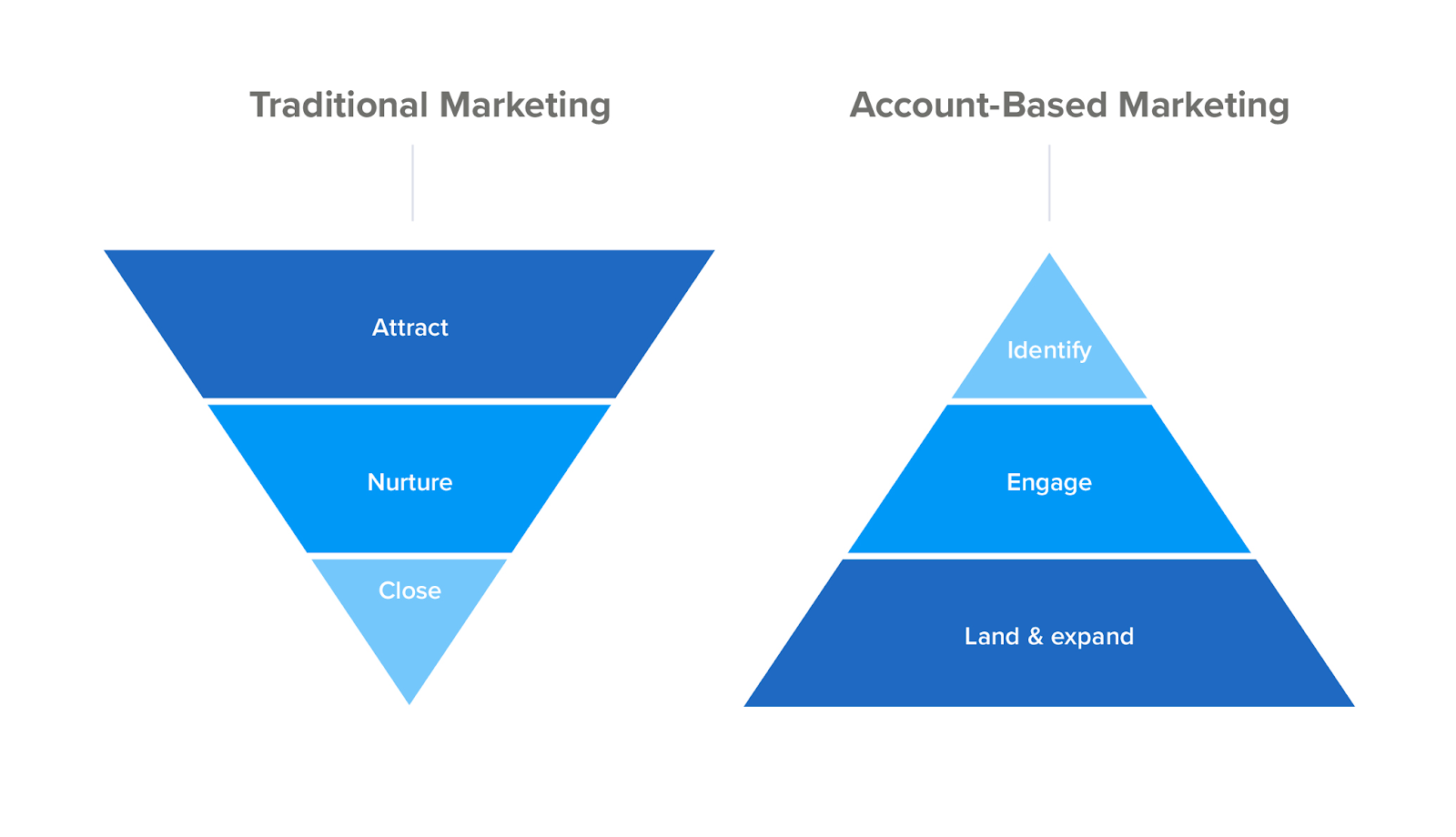
There’s nothing too complicated about it. Basically, rather creating buyer personas and orienting your B2B marketing strategy toward companies that are similar, you instead identify specific companies you’d love to have as customers, then align your strategy more directly.  Once you’re able to win an account’s business, you can shift focus to growing the partnership through upselling, cross-selling, and referrals — a technique often referred to as “land and expand.” This graphic, via SuperOffice, provides a visual explanation of how the ABM process differs from a traditional sales funnel: The prevalence of ABM is growing rapidly as B2B organizations come to embrace the logic behind it. Research found that 61% of companies reported having an established ABM practice in 2018, up from 36% in 2017. 

Combining ABM with Influencer Marketing

In general, B2B marketing is undergoing a fundamental shift — from quantity to quality. Savvy organizations recognize that meaningful engagement is far more valuable than overall reach, so they’re refining their strategies to connect with the right prospects, rather than emphasizing vanity metric volume.  At TopRank Marketing, we follow a similar mantra with influencers. It’s not about who has the most followers, or the gaudiest personal brand. It’s about who resonates most with your specific customers and prospects. ABM helps bring clarity to the matter because you can more confidently pinpoint individuals who are influential with the precise businesses you wish to win over. [bctt tweet="It’s not about who has the most followers, or the gaudiest personal brand. It’s about who resonates most with your specific customers and prospects. @NickNelsonMN #InfluencerMarketing" username="toprank"] Once you’ve defined a list of target accounts, you can begin to map out their buying committees and gather insight around the individuals who are likely to impact purchase decisions. When marrying your influencer strategy to your ABM program, you’ll want to consider questions like these:
  • Who is influential to people within your targeted accounts? Based on their professional networks and social media activities, which influencers do they pay attention to and trust? 
  • What topics do your target accounts talk about most? Try to get as specific as you can, then seek out micro-influencers and niche experts with authority in that particular area.
  • Who will the people in your target accounts be able to relate to? Authenticity is essential for influencer engagements. You’ll want to identify candidates at similar-sized companies, and with similar roles/functions.
When it comes to making a bottom-line impact, you’ll especially want to concentrate on finding partners with purchasing influence (i.e., they can speak from experience or expertise about your solution and its benefits) for co-creation of content. In essence, this knocks out two birds with one stone, assisting with the development of powerful assets that can activate the influence of your collaborators. 

Bring Focus to Your Marketing Strategy

B2B influencer marketing isn’t about enlisting the trendiest Instagram celeb with the most followers. (Well, it is for some companies, but those ones tend to struggle with it.) Instead, it’s about finding the perfect alignment with your audience. Nothing brings more clarity and precision to understanding your audience than ABM, which swaps out theoretical personas for actual organizations and people. This intersection of ABM and influencer marketing represents one of the most promising frontiers for B2B marketing, especially when it comes to the pursuit of enterprise customers. Not only do influencer partnerships help you break through and gain visibility with busy decision makers at these coveted accounts, but also drive engagement and persuasively move the needle. [bctt tweet="The intersection of #ABM and #InfluencerMarketing represents one of the most promising frontiers for B2B marketing, especially when it comes to the pursuit of enterprise customers. @NickNelsonMN" username="toprank"] Influencer marketing plays well with numbers B2B marketing tactics. Learn how influence also intersects with SEO.

The post Hitting Your Target: Why Account-Based Marketing and Influencers Are the Perfect Match appeared first on Online Marketing Blog - TopRank®.


Article Source: http://bathseoexpert.blogspot.com/2019/07/hitting-your-target-why-account-based.html

Tuesday, 9 July 2019

5 Content Promotion Tactics To Make You (Almost) Famous

Woman embracing beautiful world from a dock overlooking water image.

Woman embracing beautiful world from a dock overlooking water image. Not all forms of content creation will make you famous, but some come with built-in amplification boosts that can put you well on your way to star-quality promotion. Working with industry experts and influencers to co-create content is a proven tactic for adding more inherent promotion right from the start of your campaign. Harnessing the power of industry events, keeping abreast of trend forecast data, and incorporating interactive elements are also tactics that can significantly up your content promotion game. Let’s take a look at all of these methods and more, and see how to best utilize each, including examples showing how each tactic has driven star-quality success. via GIPHY

Tactic #1 — Co-Creation With Industry Experts & Influencers

Women's rowing team image. Whether you call them industry experts or influencers, when you work with noted figures in your profession and include their insight along with your own, you'll both reap rewards on several levels by joining together. Co-created content will by nature provide promotion potential that is greater than the sum of its individual parts, as the value and relevance industry experts add to your content makes it something that not only your target audience will want to learn from and share, but which also benefits from the additional sharing and social amplification influencers can provide. [bctt tweet="For any kind of content a business creates and publishes to the world, there is an opportunity for collaboration with credible voices that have active networks interested in what those voices have to say. @LeeOdden" username="toprank"] A recent poll on our Twitter channel asked B2B marketers what their biggest influencer marketing hurdles were: TopRank Marketing Twitter influencer marketing poll In this informal poll measuring, impact was seen as the top hurdle, which highlights the importance of having an accurate data analytics strategy. I’ve written about this in “New Year, New View: 3 Ways to Approach Analytics in 2019,” including specific tips for dealing with influencer marketing. Finding the right influencers for your industry has also been a top concern, and a key element in strong influencer partnerships is the ability to share in mutual benefits, as Luciana Moran of Dun & Bradstreet has pointed out. [bctt tweet="In order to be successful, the work has to be mutually beneficial to both parties. @lucymoran on #B2BInfluencerMarketing" username="toprank"] She shared some of the challenges and rewards of working with influencers in an interview with Lee that is a helpful resource if you're looking to develop or improve your own influencer marketing program. With multiple recent estimates predicting influencer marketing as a $10 billion industry by 2020, including 35% growth through 2025, getting influencer marketing right will be more important than ever, which is why many B2B firms turn to a professional marketing agency specializing in the practice. TopRank Marketing was named by Forrester as the only B2B marketing agency offering influencer marketing as a top capability in its latest “B2B Marketing Agencies, North America, Q1 2019” report.” [bctt tweet="“Partnering with influencers can provide a dramatic boost to your brand’s credibility and authority in the eyes of your audience.” @NickNelsonMN" username="toprank"] Here are three additional resources we've compiled recently relating to content co-creation, to help you design and implement your own influencer marketing plan:

Tactic #2 — The Promotional Power of Events

Doorway open to green pastures in an urban cityscape image. Industry events bring people together, and the collective promotional potential they offer when smartly utilized is a tactic that’s sometimes overlooked, so we’ll explore some of the ways conferences, trade-shows, and other professional events can amplify your marketing campaign efforts. [bctt tweet="Tip for creating #ContentGold around industry events: Reach out to organizers, sponsors, or speakers that represent topics and brands of interest to your community to do pre-conference interviews. @LeeOdden" username="toprank"] There are many ways to build promotion around events, and we’ve written several recent in-depth articles on the specifics which we’ll share below, including how to take advantage of the follow event-related content promotion areas:
  • Speaking at Events
  • Event-Specific Content Creation
  • Hosting In-Real-Life (IRL) Gatherings at Events
  • Participating in Podcast Interviews
  • Being Social During Events
  • Finding Event-Related Hashtags
  • Connecting with Speakers, Exhibitors, and Other Attendees.
  • Starting Event-Related Buzz
  • Scheduling Event-Related Content
  • Joining Private and Public Event Discussion Groups
  • Sharing Interesting and Inspiring Speaker and Keynote Quotes
  • Inviting Key Industry People to Meet Up
  • Amplifying Event Content and Engaging with Attendees
  • Giving Social Shout-Outs to Those You Meet
  • Sharing Top Session and Keynote Take-Aways
  • Forming New Connections with Speakers, Exhibitors, and Attendees
  • Savvy Surveying of the Event Schedule
[bctt tweet="“Publishing content (in many forms) is a great way to retain and share the information you gather at these events.” @azeckman" username="toprank"] To get you started in event-related content promotion and how to utilize the items listed above, here are three recent articles we're written:

Tactic #3 — Promotion From Relevant Trend Research

B2B Influencer Marketing Trends Knowing where your industry is and where it has been are important factors in creating top-quality, relevant promotional efforts, however what can set a campaign apart is having the forward-thinking insight that can only come from a thorough examination of future trend forecast and analysis information. Our CEO Lee Odden recently shared his latest trends relating to B2B influencer marketing, published in infographic format at Social Media Today, in “The Top B2B Influencer Marketing Trends for 2020 [Infographic].” [bctt tweet="“Not only is influencer marketing one of the fastest growing areas in marketing, it's also one of the disciplines where B2B brands are seeing trend-setting marketing performance.” @LeeOdden" username="toprank"] Finding relevant trend and forecast report data can be a daunting challenge, but it's well worth the effort for the added insight you’ll gain and be able to include in your marketing efforts. We’ve made it easier than ever to locate some of the top recent reports, with our recently-published “15 Reports Charting the Future of Content Marketing,” featuring new trend data from the Pew Research Center, Edelman, Edison Research, Cision, Shutterstock, Mary Meeker, Buffer, LinkedIn, Content Marketing Institute, MarketingProfs, Chief Marketer, Vidyard, Triton Digital, Sprout Social, Social Media Examiner, Hootsuite, and We Are Social. [bctt tweet="“Finding trends in what your current customers need can help you answer questions that your prospective customers might be asking, too.” — Jessica Best @bestofjess" username="toprank"] Below you’ll also find three addition resources for not only locating existing trend publications, but for digging in and doing your own research using audience intent and question research tools. [bctt tweet="“Find out what questions your customers are asking and answer them with your content.” @LeeOdden" username="toprank"]

Tactic #4 — Inclusive Use of Your Digital Archives ; Re-Purposing

Grand research library image. The longest journeys in life, and indeed the adventures of life itself, aren’t taken in one fell swoop, but in a continual series of steps that each build on previous steps. The information in the content we create is similar, and if we wish to build inspiring and life-changing content, we shouldn’t ignore the wisdom that has come from our prior work, which is where content re-purposing comes in ready to shine. Some information that you’ve previously published will be the type of always-relevant evergreen content that can add to the usefulness of new campaigns, and smart marketers will re-use it, oftentimes adding slight modifications or improvements. [bctt tweet="We don’t need more content. We need better content! @annhandley of @MarketingProfs" username="toprank"] Re-purposing can help create a more authentic type of content as well, and provide the kind of best-answer content that audiences are seeking. [bctt tweet="“Using a modular approach will make the repurposing process easier, keyword relevant and meaningful for the audience because topics are driven by an understanding of customer interests, questions and triggers.” — Lee Odden @leeodden" username="toprank"] Here are three recent articles we've written to help you successfully re-purposing content:

Tactic #5 — Promotion Using Interactive Elements

Woman using virtual reality image. With our fascination in two-way online experiences instead of traditional passive one-way content, it shouldn’t come as any great surprise that elements of interactive content have some of the highest engagement rates of all. Since 2016 93% of marketers have viewed interactive content as effective in educating buyers versus just 70% for static content, according to survey data by Inc. and others, with similar figures continuing through today. As the technical capabilities of the Web have grown significantly since its inception, more than ever before audiences are seeking out and expecting the type of content they can engage and interact with beyond merely clicking links. Whether it’s live-chat — either automated or with an actual person — real-time virtual reality (VR) or augmented reality (AR), in-content playable moments, or any number of the new methods for two-way online communication, adding interactive elements to your content is a fantastic way to build a stronger connection with your customers and target audience. [bctt tweet="“Creating compelling experiences with interactive content is one way to stand out, differentiate, and optimize for effectiveness.” @LeeOdden" username="toprank"] For its recent “Reshaping Customer Experience Management: The Future of #CXM” campaign, *Adobe worked with TopRank Marketing to create a unique interactive online story featuring a wealth of helpful B2B influencer content to increase awareness of Adobe’s Customer Experience Management solutions. The campaign combined expert insight from top industry experts including Jay Baer of Convince & Convert, Ann Handley of MarketingProfs, Scott Monty of Scott Monty Strategies, Rachel Richter of Dun & Bradstreet and others, with enticing and useful interactive elements to bring Adobe’s CXM to life. Adobe Reshaping The Customer Experience image. [bctt tweet="“Interactivity boosts content effectiveness no matter what your goals might be. Creating awareness, educating customers, driving leads, or attracting talent, content is more engaging when it invites the reader to play along.” @NiteWrites" username="toprank"] Another recent poll on our Twitter channel asked B2B marketers which element offered the biggest performance increase potential in a blog post: TopRank Marketing Twitter poll visual elements results Interactive elements was the top choice in this informal poll, highlighting their power to drive engagement. YouTube recently announced new augmented reality (AR) advertising options, which will be available later this summer through its influencer marketing platform, FameBit — an example of how the world’s largest video platform is expanding its use of interactive content elements. Finally, here are three helpful interactive experience resources for marketers looking to begin or start utilizing the power of interactivity:

Be Your Own Best Content Promotion Shining Star

via GIPHY Content promotion fame isn’t in the stars for every campaign, however by using influencer co-creation, harnessing the power of events and trends, and incorporating smart re-purposing with engaging interactive elements, you’ll be that much closer to the red carpets of Cannes. *Adobe is a TopRank Marketing client.

The post 5 Content Promotion Tactics To Make You (Almost) Famous appeared first on Online Marketing Blog - TopRank®.


Article Source: http://bathseoexpert.blogspot.com/2019/07/5-content-promotion-tactics-to-make-you.html

Monday, 8 July 2019

Making the Case for Video at Every Stage of the Buyer’s Journey

Video Marketing Statistics for Each Stage of the Buyer's Journey

Video Marketing Statistics for Each Stage of the Buyer's Journey It’s been said before, but I’ll say it again: Video across the digital landscape is what buyers and consumers alike crave. The average U.S. adult spends 5 hours and 57 minutes a day watching video. Compare that number to the average amount of time someone reads each day (16.8 minutes), and you’ll find that people watch videos over 21-times longer than reading text. Video informs, engages, and entices audiences, which means video can and should have a place within your B2B content marketing strategy. But when and how should you leverage video? It’s not just a top-of-funnel tactic reserved for B2C brands. And here are the *stats that showcase it’s potential.

15 Video Marketing Statistics for Every Stage of the Buyer Journey

Attract

  1. 84% of marketers credit video with increasing traffic to their website. (3)
  2. 87% of people would like to see more video from brands. (3)
  3. 82% of all internet traffic will be video by 2021. (4)
As we covered earlier, more and more people are spending an increasing amount of time watching video online. And that includes your buyers. For your marketing messages to capture and pull in your target audience, it needs to be in a place and in a format they prefer. Today, one of those important formats is video. From teaser videos to trailers, these video types are great for generating excitement and holding your audience’s attention, making them perfect for the awareness stage of the buyer journey. Here’s a little something from the TopRank Marketing vault, introducing a new interactive experience featuring insights from several marketing industry experts. [embed]https://youtu.be/ZMHSu-SYo8E[/embed] Top-Performing Video Types: Trailers, Teasers & Brand Video

Engage

  1. People watch videos with subtitles 40% longer than videos without subtitles. (1)
  2. 52% of viewers watch a video all the way through. (2)
  3. 68% of people would rather watch a video to learn about a product or service rather than read about it. (3)
  4. 80% of marketers credit video with increasing the average time on page for their website. (3)
B2B videos can range from mere seconds in length to a full hour. Buyers in the engagement stage are likely considering their options, weighing potential solutions to their problem. Videos that explain how your products or services can solve problems are great for this stage. In addition, video reviews also help give your target audience the information they’re looking for, increasing engagement rates with your brand and videos. Here’s an example from **Dell Outlet, teasing the insights they’ve gathered from an array of small business experts and entrepreneurs on making smart tech purchases. Top-Performing Video Types: Explainers, Reviews

Convert

  1. 83% of marketers say video results in a good ROI. (3)
  2. 79% of people say a brand’s video convinced them to make a purchase. (3)
  3. 81% of marketers say video has helped them generate leads. (3)
  4. Including a video on a landing page can increase conversion rates by 80%. (6)
Video is a great learning tool. In fact, approximately 65% of the global population are visual learners. And the more your audience understands and is knowledgeable about your solution, the more likely they are to purchase it. Together, this makes video an excellent way to convince your audience of the value of your product or service.  What types of video are best for the conversion stage of the funnel? Live or on-demand webinars are an excellent way to give your target buyers an in-depth, detailed look at your solution and the benefits you offer. In addition, video testimonials from actual customers are an authentic way to communicate your brand’s value and why you’re a crucial partner across company types and industries.  Top-Performing Video Types: Webinars, Testimonials

Retain

  1. 41% of marketers say video has reduced their number of support calls. (3)
  2. 86% of viewers say they regularly turn to YouTube to learn something new. (5)
The buyer journey doesn’t stop with a sale. Retention is just as important, if not more so considering the fact that it costs 5-times more to acquire a customer versus retain one. To help you hold on to your customer base, video is a great tool for continuing education and problem solving for your audience. Whether it’s a tutorial video or a video essay, videos are excellent education tools that keep your customers around longer. For example, Salesforce provides several how-to and troubleshooting videos on its Salesforce Support YouTube channel to make it easy for its customers to find solutions and guidance. [embed]https://www.youtube.com/watch?v=2st8AdTUrsk[/embed] Top-Performing Video Types: Tutorials & Video Essays

Advocate

  1. 74% of consumers share video content from brands on social media. (7)
  2. Videos receive 21.2% more interactions on Instagram compared to images and 18.6% more interactions compared to carousels. (7)
Yes, marketers want to win new business and encourage return customers. However, another common item on a marketer’s wishlist is to transform buyers (and even employees) into raving fans that advocate for their company to fellow colleagues, peers, and partners. Given the virality of video content, especially on social networks, video marketing is a great opportunity for promoting advocacy within your audience.  To encourage greater advocacy through video, create videos that have the sole purpose of being watched and shared over social networks. These could be short, exciting videos that tease a new product launch or a video that highlights your company culture. Regardless of the topic, it’s important that the video contains something worth sharing and advocating about to others. Top-Performing Video Types: Teasers, Trailers & Cultural Highlights

In the Director’s Chair

There’s a reason why 64% of B2B marketers increased the amount of video content they produced in 2019—it’s effective. And it’s effective across the buyer journey. From attraction to conversion and beyond, video marketing brings B2B brands closer to their buyers. As the person in the director’s chair, now is the time to expand your video marketing (if you haven’t already). What kind of videos should you be making? Check out our breakdown of four different types of B2B videos to learn which ones are best for your brand and marketing goals. *Sources:
  1. Databox
  2. Vidyard
  3. Wyzowl
  4. Cisco
  5. Google
  6. Unbounce
  7. Sprout Social
**Disclosure: Dell Outlet is a TopRank Marketing client.

The post Making the Case for Video at Every Stage of the Buyer’s Journey appeared first on Online Marketing Blog - TopRank®.


Article Source: http://bathseoexpert.blogspot.com/2019/07/making-case-for-video-at-every-stage-of.html