Wednesday, 11 November 2020

7 Keys To Successful B2B Influencer Marketing: New Research From Lee Odden at #MPB2B

Businessman looking intently at computer image.

Businessman looking intently at computer image. MarketingProfs educational content director Kerry O'Shea Gorgone kicked off an insightful #MPB2B Forum 2020 session with our CEO Lee Odden exploring B2B influencer marketing, “New Research: How to be Successful With Influencer Marketing.” Lee began by explaining that when it comes to B2B influencer marketing, to create and maintain a successful program you've got to do the hard work and be smart about it, and set about to demystify some of the lesser-known aspects of B2B influencer marketing by sharing what he’s learned from having been deeply involved with the practice for the past eight years. Let’s take a look at the new B2B influencer marketing research Lee explored in his insightful MarketingProfs B2B Forum #MPB2B 2020 session.

1 — Utilize Influencers to Rise Above Pandemic Uncertainties
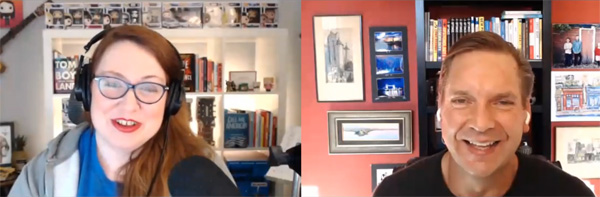
Kerry & Lee Odden #MPB2B The pandemic has given rise to many new challenges that B2B marketers have had to deal with, including budgets that are often on hold while at the same time sales goals are not, leading to high levels of uncertainty. B2B influencer marketing offers a powerful solution for rising above these uncertainties, by unleashing the power of collaboration with experts, Lee noted. While we’ve been used to buyers actively looking for solutions, there’s a greater reliance on content today, making the trustworthiness of content sources more important than ever, Lee pointed out. To help address the issue of trustworthiness and how B2B influencer marketing can help marketers now more than ever, Lee explained how TopRank Marketing produced the industry’s first 2020 State of B2B Influencer Marketing Report, with groundbreaking insights from 20 top B2B brands. Lee shared how the report’s data makes it clear that B2B influencer marketing:
  • Improves customer experience (CX)
  • Positively impacts marketing overall
  • Increases brand awareness
  • Improves lead generation
  • Builds brand reputation and advocacy
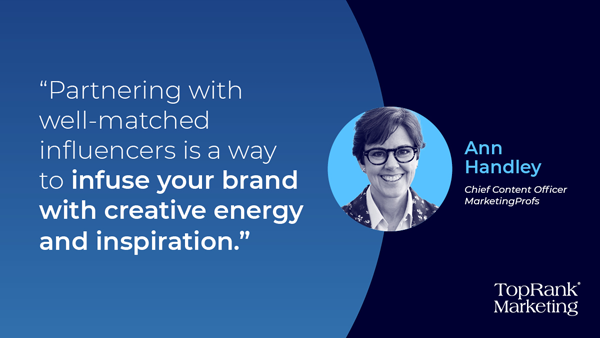
“Partnering with well-matched influencers is a handy way to infuse your brand with creative energy and inspiration,” #MPB2B's Ann Handley, who is among the top B2B marketing experts included in the report, observed. Ann Handley Report Image [bctt tweet="“Partnering with well-matched influencers is a handy way to infuse your brand with creative energy and inspiration.” — Ann Handley @MarketingProfs" username="toprank"]

2 — What Will Effective B2B Influencer Marketing Look Like in 2021?

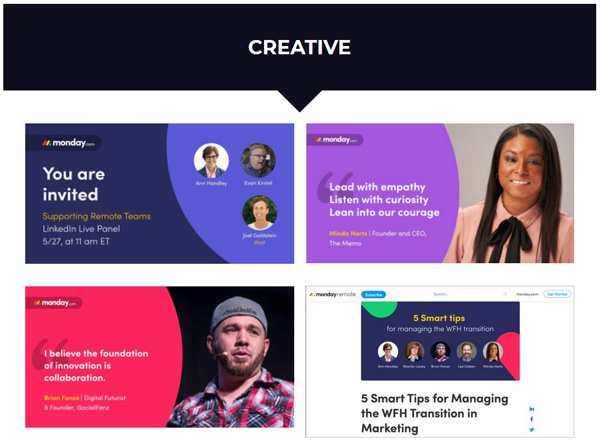
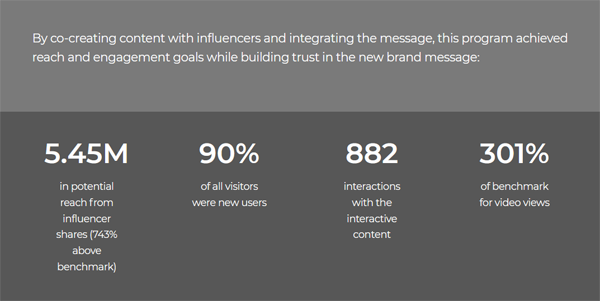
Using remote work company monday.com* as an example, Lee shared how B2B influencer marketing had helped the platform achieve social reach from influencer shares of brand content that reached 1,790 percent above the target goal. Lee also explained how monday.com successfully utilized B2B influencer marketing to partner with remote work experts and to drive discussions via live-stream that resulted in exposure to thousands of potential customers. monday.com Image In another example, Lee showed how IT service management software firm Cherwell Software* used B2B influencer marketing to achieve 342 percent better click-through-rate (CTR) on influencer content, and how the firm was successfully able to use influencers to build trust around a topic they hadn't previously been known for, resulting in some 90 percent entirely new people in their database. Cherwell Image LinkedIn* served as another powerful example shared by Lee, who explained how the professional social media platform created a strong community of 75 influencers — recognizing the importance of investing in influencer relationships, and also the growing need for always-on B2B influencer marketing programs. Lee shared how LinkedIn had partnered and developed relationships with influencers, how it was able to create a community of respected voices that became an ongoing voice of the brand, and how doing so allowed LinkedIn to be the best answer for its customers.
3 — What Makes B2B Influencer Marketing Content So Special?

B2B influencer marketing adds invaluable third-party credibility and trust to content, Lee said, also noting that it helps to extend content creation and expertise and to infuse the voice of the customer in your brand content, creating powerful trusted voices. It also offers the added benefit of creating the type of inspiring promotion that traditional advertising may not be nearly as successful in doing, Lee suggested. Lee then focused on steps B2B marketers can take to achieve success with an influencer marketing program.

4 — Scaling With Strategy

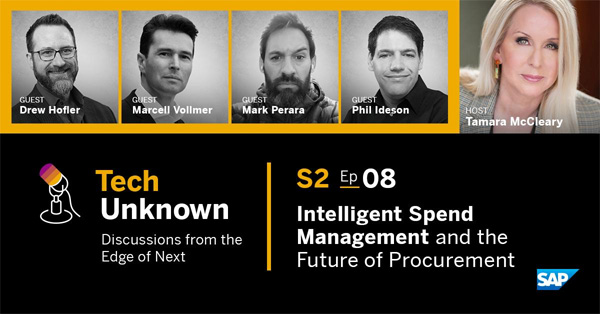
Scaling with strategy begins with finding the topics most relevant to your business, and Lee used an example from SAP*’s Tech Unknown podcast. The podcast came about as a way to serve both internal customers and multiple external audiences, using an industry influencer — in this case technology futurist Tamara McCleary — as the podcast’s host. SAP Image Lee shared how influencers serve multiple uses for the SAP Tech Unknown podcast series, now in its third season, and how by following best-practices the podcast’s content has also been successfully repurposed into eBook and other content formats.
5 — Understand Topical Demand Using Specialized Software

Lee shared how using tools including SEMrush and BuzzSumo can play an important role in  helping to answer customer questions from third-party experts, and also explained how using the right software makes it possible to validate ideas with relevant data. Lee recommended data-driven influencer marketing platform Traackr to help qualify and validate potential influencers and discover whether they have the right tone of voice, cadence, and other relevant criteria. When it comes time for publishing B2B influencer marketing content co-created with influencers, it’s important to incorporate blog content as a part of your organization’s overall content publishing strategy, Lee noted, as it’s a vital part of the diverse array of content publishing formats that should be utilized when sharing co-created influencer content.

6 — Use an Always-On Engagement Strategy

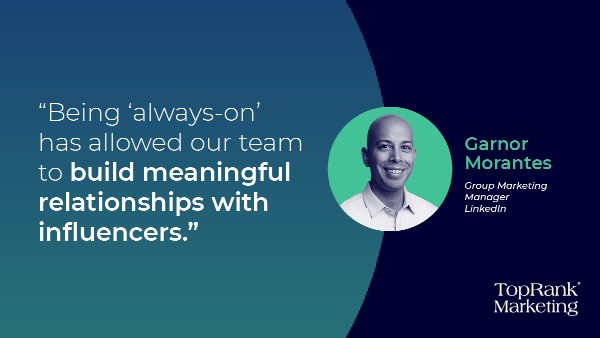
Lee stressed the growing importance of an always-on engagement strategy, citing research from the 2020 State of B2B Influencer Marketing Report showing its effectiveness, and sharing a quote from Garnor Morantes, group marketing manager at LinkedIn: "Being 'always-on' has allowed our team to build meaningful relationships with influencers," Garnor said. Garnor Morantes Always-On Influence Quote [bctt tweet="“Being 'always-on' has allowed our team to build meaningful relationships with influencers.” — Garnor Morantes of @LinkedIn" username="toprank"] An always-on approach that’s centered around creating relationships helps build community and advocacy, Lee explained, noting the importance of playing the long game. Lee presented a case study showing the effectiveness of B2B influencer marketing, from Alcatel-Lucent Enterprise (ALE), which created a successful IT Vanguard Awards program using IT industry influencers  as judges. The awards program shared the advice and insight of honorees and helped to make them into influencers, Lee noted of the program, which went on to win an award at the 2020 Content Marketing Awards. IT Vangards Lee explained how TopRank Marketing has a proven process of working with influencers for many of the top brands on the planet such as Adobe, LinkedIn, Dell, 3M and others, and he urged those considering a B2B influencer marketing program to look closely at who really influences your buyers. Only then can you move forward with investing in and executing a successful influencer program, Lee observed, which could start with outside help in the form of a pilot B2B influencer marketing program. By using the insight gained from a pilot influencer program, B2B marketers can further build an influencer strategy, grow a content community of influencers, and activate return on investment (ROI), Lee noted as he concluded his #MPB2B presentation.
7 — Bonus #MPB2B B2B Influencer Marketing Insight

During the post-session question and answer period, Lee was asked for advice writing about non-marketing-related content, and he urged marketers to always strive to empathize with the audience, and to make content meaningful to them. Using an example of a shareable social media message, Lee noted that tweets created for influencers won’t work nearly as well when an organization’s entire team shares these same messages, and instead recommended the messaging be changed to better suit those sharing the content in a more general way. Lee was also asked whether B2B influencer marketing can also work for smaller firms, and he shared several examples of TopRank Marketing’s work with small-to-medium size businesses (SMBs), utilizing locally influential people, for firms such as Welter Heating and Prophix Software. Welter Heating was able to utilize local celebrity influencers to poll and gather feedback, giving them something fun, easy, and interesting to do, which was then made into round-up posts for the company’s website, Lee noted. Lee explained how despite the fact that financial management software solution provider Prophix Software was centered around a fairly niche topic, they were able to find relevant specialized influencers that fit and worked well. Prophix Influencer Marketing Example Asked to provide a quick tip for getting started in B2B influencer marketing, Lee suggested making and publishing a list of the people who are influential in your particular industry, as a way to honor them and then also to use as an opportunity to follow up with each person with a brief and easy-to-fulfill request for a future co-collaboration project such as an interview or eBook. While B2B influencer marketing had previously been roughly 80-90 percent of the unpaid variety, that number is now up to around 25 percent paid, Lee said, noting that there are now more B2B professionals who bring to the table the type of influencer skills worth paying for, such as much more robust and relevant content from brandividuals. When asked about budgeting, Lee suggested that B2B influencer marketing can be budgeted as with any other advertisement expenditure, and explained how using paid influencers can be a great way to find and recruit lesser-known influencers. Lee suggested that it’s helpful to have a long runway for building influencer relationships, and explained how TopRank Marketing was able to find remote work experts for client monday.com by  using Traackr and a variety of other criteria to those most influential around the topic, along with those who have a community of followers that will respond to that topic. These join other metrics including network size, publishing cadence and format, along with the influencer’s particular values, Lee noted, before they are ultimately approved by the client. Another question Lee fielded was who within an organization should run a B2B influencer marketing program, and he noted that in the early days of influencer marketing it was likely to be the director of marketing or people in social media roles — all community-oriented professionals. As time has passed, Lee explained, with B2B influencer marketing having grown in both success and sophistication, new dedicated roles are being created, such as those held by people including Rani Mani, head of global employee advocacy at Adobe*, and Ursula Ringham, head of global influencer marketing at SAP, and there has also been more integration with other departments at organizations. Lee’s final question was whether B2B influencer marketing could be used to test new markets, and Lee shared how it can be successfully used to find new marketing topics by conducting tests with various content formats to see how each resonates, before ultimately deciding whether to scale or bail, Lee noted. Learn more about B2B influencer marketing from Lee by watching our #InsideInfluence series, including the latest episode "Inside Influence EP06: Amisha Gandhi from SAP on the Power of Mutual Value in B2B Influencer Marketing." Be sure to check out our additional #MPB2B 2020 coverage listed below: Want further help? Contact us and find out why brands from SAP, LinkedIn, AT&T Business, and Adobe to IBM, Dell, Cherwell Software, monday.com and more have chosen TopRank Marketing. * monday.com, Cherwell Software, LinkedIn, SAP, Welter Heating, Prophix Software, and Adobe are TopRank Marketing clients.  
The post 7 Keys To Successful B2B Influencer Marketing: New Research From Lee Odden at #MPB2B appeared first on B2B Marketing Blog - TopRank®.


Article Source: http://bathseoexpert.blogspot.com/2020/11/7-keys-to-successful-b2b-influencer.html

Tuesday, 10 November 2020

Incredible Content Marketing: 6 Tips for Infusing Credibility into B2B Content

Business-woman at Computer Image

Business-woman at Computer Image One of my favorite moments from The Simpsons is when the hilariously incompetent physician Dr. Nick burns down a building by mishandling a clearly marked chemical tank, and then exclaims, “Inflammable means flammable?! What a country!” via GIPHY “Incredible” is a word that can spark similar cognitive dissonance for marketers. Sure, it might technically be defined as “impossible to believe,” but if your content isn’t credible, would anyone describe it as incredible? Quite the opposite. In this business, incredible means credible. So let’s explore the cornerstones of creating credible, and thus truly incredible, content marketing.

6 Tips for Making Your B2B Content (Incredibly) Credible

Just as you can’t fake authenticity, you can’t fake credibility. This label is earned by brands over time by developing a trusted voice, showing up for your audience, and — above all — knowing what you’re talking about. With these being table stakes, today’s post examines how you can make sure this foundational credibility is showing up in the content marketing you create and distribute. Speaking of table stakes:

1 — Don’t lie to your audience

We’re living in an age where misinformation runs rampant. Frankly, it can make the entire experience of being online very draining and exhausting. And while folks might have no choice but to put up with the zany Facebook post by their uncle, or the click-baity headline on Google News, they are less likely to tolerate it from companies they do business with. To be clear, I’m not under the impression that many B2B brands are out here attempting to flat-out fib to people. On this subject, I’ll make two points:
  1. It’s all too easy to be untruthful with your audience unintentionally. If careless, marketers can fall into the same disinformation traps that plague many users of the web. Always fact-check and verify information before sharing it with your audience, and don’t make a habit of running with assumptions.
  2. Shying away from the truth isn’t much different from lying. It might not feel dishonest to downplay your solution’s weaknesses, or hide negative reviews, but will your customers feel the same?

2 — Gain credibility through association

One of the primary advantages of influencer marketing is that it allows brands to co-opt the credibility of respected experts and business leaders they partner with. When audiences see these individuals collaborating with a company, producing useful and enjoyable content together, it infuses an instant element of trust. It is not enough to simply activate influencer marketing, though — be strategic about it. Identify influencers who truly fit with your brand values, and aim for transparent authenticity in your engagements. In other words, beware of pay-to-play. As Lee Odden put it in an interview with Brand24: “Without clear alignment between the brand, influencer and audience, the program won’t resonate and everyone loses credibility.”

3 — Be thoughtful about where your content is showing up

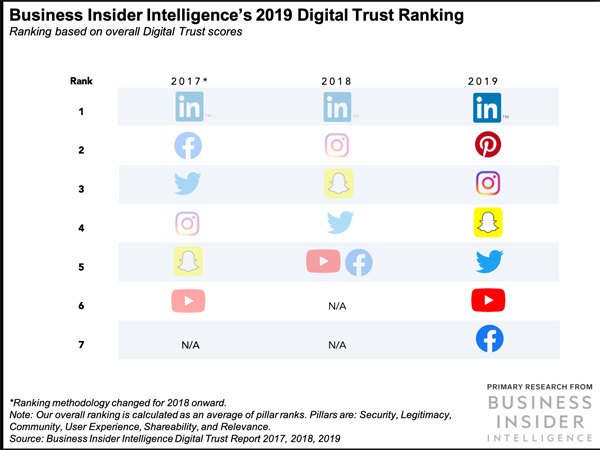
Your brand’s associations aren’t limited to “who”; there is also the matter of “where.” Credibility can be affected by the reputations of platforms where content is distributed, and by the other content that appears around it. In the social media sphere, Business Insider’s Digital Trust Report has found LinkedIn* to be the platform most trusted by users three years straight, and what’s especially interest to note is the dramatic drop-off Facebook has seen over this span: Business Insider Chart Nearly half of the respondents (47%) in Business Insider’s 2019 report said they think Facebook is “extremely likely” to show them deceptive content. I wrote on this blog recently about the B2B implications of the Facebook advertising boycott. This isn’t to say marketing on Facebook is a universal cred-killer, but it’s something that should increasingly be weighed in your decision-making. Any podcast your brand representatives appear on, or blogs they guest-post on, should also be vetted deeply. Just as you can gain credibility through association, you can also lose it.

4 — Put your brand’s purpose forward

I like to frame a company’s relationship with its purpose as that between the Earth and the Sun: Not so close that it’s constantly in your face, but always within view, and all of your marketing activities orbit around it. There are many benefits to being a purpose-driven brand, but the credibility factor is a big one. Credibility is built, in part, through consistency. Staying true to a clearly articulated guiding mission is one of the simplest ways to demonstrate consistency, even amidst rapidly changing conditions. Kim Davis of MarTech Today recently highlighted Deloitte’s seven marketing trends for 2021, which are geared toward “breaking out of our often defensive mindsets to more holistically — and authentically — meet human needs.” The first item on the list is purpose. And I might argue that the following six confidence-building touchstones – agility, human connections, trust, participation, fusion, talent transformation – all feed off it. Like planets orbiting the Sun.

 5 — Elevate the voices of your community

Companies aren’t credible. We can say they are, as a shorthand, but nobody actually finds a business entity trustworthy or dependable on its own. Credibility is driven by the people behind the brand, and by its advocates. Do all you can to showcase those individuals and continually reinforce their loyalty. Customers and employees come together to form your brand’s community. People see themselves in the reflection of the community, not the company logo or product features. So if you want to build credibility, lift those voices up. In the past, we’ve preached the value of user-generated content and employee advocacy. More recently, Cara Sloman wrote at Entrepreneur about the power of customer champions for trust and credibility.

6 —Make the commitment and investment to do marketing well

At the end of the day, actions — and results — speak louder than words. Nothing is more credible than a piece of content that is downright GOOD – where it is clear that serious effort and expertise were channeled into creating something that would connect and make an impact. You can’t manufacture the credibility of ranking first in Google for a keyword you want to own, or building a large and engaged following on social media, or boasting heartfelt customer testimonials on your website. These things don’t come easily or automatically. And they’re never earned by taking the easy route. Jeff Bezos once said, “A brand for a company is like a reputation for a person. You earn reputation by trying to do hard things well.” Say what you will about the Amazon overlord, but no one can deny he’s got credibility on the subject of growing a modern business. Want help making your content marketing more credible AND incredible? Reach out to our team at TopRank Marketing. * LinkedIn Marketing Solutions is a TopRank Marketing client

The post Incredible Content Marketing: 6 Tips for Infusing Credibility into B2B Content appeared first on B2B Marketing Blog - TopRank®.


Article Source: http://bathseoexpert.blogspot.com/2020/11/incredible-content-marketing-6-tips-for.html

Monday, 9 November 2020

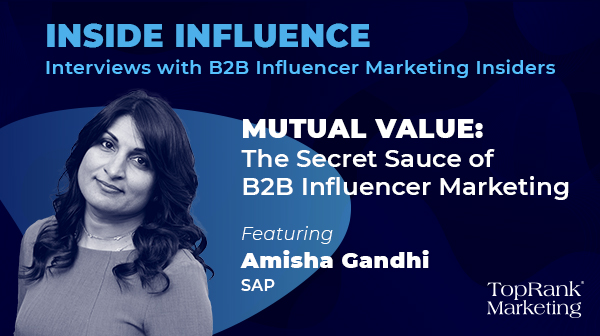
Inside Influence EP06: Amisha Gandhi from SAP on the Power of Mutual Value in B2B Influencer Marketing

Amisha Gandhi SAP Inside Influence

Amisha Gandhi SAP Inside Influence The latest edition of Inside Influence features B2B Influencer Marketing "OG", Amisha Gandhi, VP Influencer Marketing & Communications at SAP. At TopRank Marketing, we've had the pleasure of working with Amisha for several years on a variety of influencer marketing programs from the launch of SAP Leonardo to developing a virtual reality experience featuring influencers for use at tradeshows. In this 6th episode of Inside Influence, I talk with Amisha about the power of how creating mutual value between B2B brands and influencers drives returns across the customer lifecycle. Of course we also hit a few highlights of the 2020 State of B2B Influencer Marketing Report. In this 6th Episode of Inside Influence, we cover:
  • The impact of the pandemic on influencer marketing for B2B brands
  • How influencer marketing fits in the marketing mix
  • What mutual value creation means for B2B brands and influencers
  • The difference between B2C and B2B influencer marketing
  • When to pay influencers
  • Why Always-On influencer marketing is more powerful than campaigns alone
  • How to win budgets for influencer marketing programs
  • Where agencies can be most helpful for B2B brands with influencer marketing
  • Top B2B influencer marketing mistakes
  • Looking forward to post-pandemic influencer marketing
Here are a few highlights with the full video interview embedded below. You know as much as anyone the impact that the pandemic has had on people’s lives and on business. What has the impact been when it comes to B2B influencer marketing? Amisha: I think (B2B) people are definitely looking at their entire customer journey as now completely digital. I think you see an increase in digital social selling and you see an increase in digital demand gen if it wasn't already. And with more maturity, many have now made that shift. People are looking at creating more engaging online experiences and virtual experiences now.

Many (B2B marketers) have had to go a hundred percent digital overnight and that just creates a really great opportunity for influencer marketing. @amishagandhi

I think many had to go a hundred percent digital overnight and that just creates a really great opportunity for influencer marketing. When you think about the customer journey, because we're really trying to create conversations and engagement, now everything has to be done virtually, right? So even live experiences with your influencers, customers, employees, everyone has to be online. I think it just creates that opportunity for us to work with influencers, to manage and make those experiences as valuable as possible. The research we did for the State of B2B Influencer Marketing Report found that B2B marketers are engaging influencers for content that does everything from build brand awareness (84%) to help generate leads (69%). Do you view influencer marketing as something you apply to specific objectives or can it be used more broadly? Or both? Amisha: I think both, but it depends on what you're trying to do. Something that we always talk about and we agree on is that influencer marketing, when you're creating it, should be an ongoing relationship. It's almost like you want to create a community of influencers around your business. Or if you're at a large place like SAP, around the topic that you're really trying to influence and the persona that you're trying to influence. You really want to think about that long term aspect of it.

Influencers can really help you broadly, but they can also help you at every step of the customer journey. @amishagandhi

These influencers can really help you broadly, but they can also help you at every step of the customer journey. Think of how you can infuse influencers into those motions all the way across the customer journey, so when you do a campaign, you have influencers from awareness all the way down to advocacy. You’ve said many times that effective influencer marketing is about mutual value creation. What do you mean by that? Amisha: Sure. There are people who are influencers and that's their business. But I think there are a lot of influencers, especially in B2B who are developers, who are actual implementers of technology, or they're in the position of influence like CIO of CFO. Some of them have written books and some of them are academics. It depends, but they have some sort of inspirational guidance out there, right? And people follow them for reason. When you're working with folks like that, it's not always a contract. There's value for them as well. For example, it could be, you know, we have a large ecosystem partner ecosystem at SAP. Some of our influencers are also partners and some of the partner organizations like to come and do business with us, so we're making introductions into our ecosystem on behalf of the influencer. They're actually doing business with us or with our partners. We're actually building business together. That's not to say that they're out there endorsing SAP, but they're a little bit more involved. So they're getting that intrinsic value. For other folks there is the contract, but again, if you have the long-term relationship, it becomes less about the contract than the work. If you're asking people to do a keynote or if you're asking them to write long articles or to do thought leadership, you're paying them for work.  I'm not paying them to endorse SAP. I'm paying them because they've interviewed tens of customers and they're writing a really thorough piece of content and that's their job. It's based on their knowledge.

There is mutual benefit in building business together and asking your influencers, what do you want out of the relationship? @amishagandhi

So it depends. There are influencers we don't pay at all. There are other influencers we pay some for certain activities and the others not. If we're asking for a quote for an ebook and it takes somebody a couple of minutes and they're a really great thought leader, they're involved in that way. Longer pieces of content like a keynote, we pay for. You don't want to take people for granted. You want to create that relationship. There is mutual benefit in building business together and asking your influencers, what do you want out of the relationship? And really getting to know them and saying, how can we help you beyond just this? I think it works both ways because they'll come back and ask you the same thing and you're going to get this amazing value. Both ways. Activating influencers to co-create B2B content might work great, but no program is getting off the ground without budget. What recommendations do you have for winning budget to do a pilot or even a longer term program? Amisha: Budget is an issue for everyone these days. I can say that I started with no budget and I had to pitch my other marketing colleagues for pieces of their budget to actually do influencer marketing right and I started a global demand gen team. So what you really have to do is, is explain: here's the context of what this is and here are the outcomes that you can expect. Of course, a lot of these were just guesstimations because there wasn't anyone else I could look at it and say, who's doing demand gen? Who's doing ABM? Or who's doing a kind of co-created content with influencers? I had a lot of B2C industry stats for influencer marketing that were very helpful, but I had to have a very pointed sort of conversation about, here's what we're going to do and here's what that could look like. A program could be an ebook or some sort of event speaking engagement and then you could get some promotion out of that. Another thing was, here is some kind of demand gen content that could really work in your campaign. So you have to have a menu of options and outcomes to show what the context is. This is why it's important and here's some of the things I can do for you, business or marketing team. Plus, here's the outcomes that you can expect. When you have that, then people are like, Oh, okay. It's not just an idea. We're going to see what happens. When I started I wasn't getting anywhere, so I had to be really pragmatic. Once I did that and showed the value, then people said, okay I can see that this will have some impact on what I'm doing to help me with my marketing campaign. Okay. Let's see, let's try it out.

My inbox was getting full because people saw the value (of influencer marketing). They saw it in action and they experienced it themselves. @amishagandhi

And that's how I got a pilot from the CIO group at SAP. We started with an event and an ebook and they both did really well. Then we were able to share that with all the other teams and my inbox was getting full after that because people saw the value. They saw it in action and they experienced it themselves. You want to be open about outcomes and communicate the outcomes and make it valuable to the person you're talking to. So, know who you're talking to and know what they're about and know what they're trying to achieve. Know how you can help them have the outcome and then always report back and try to share those results so that they can experience it themselves. Because once they do, then they will just want more and will want to think about it in a different way than, Oh, this was an ebook. No, actually, let's think about it in a bigger way. And then that's how you're going to say, here's the vision and here's how we can get to the bigger plays with influencers and make it a part of our marketing stack. In the 2020 State of B2B Influencer Marketing Report, we found that the things B2B marketers outsource most often to agencies include: identifying influencers, managing relationships, developing strategy and measuring effectiveness. What have you found to be most useful when it comes to using outside help? Amisha: So I started in-house first and then eventually started working with folks like you (TopRank Marketing). We share the same philosophies which is really important. For identifying influencers, yes, you should get outside help. But there are also lists out there. You want to verify those things. Once influencers have been identified, you should be part of the relationship development and the relationship. I think when you outsource the relationship, it is very difficult to create that ongoing community.

You can certainly have the help of an agency to help manage the relationship, but I really feel strongly that the relationship that the influencers want is with the brand and not with the agency. @amishagandhi

You can certainly have the help of an agency to help manage the relationship, but I really feel strongly that the relationship that the influencers want is with the brand and not with the agency. Now, if the agency is a player in that industry, that's great and it helps. But again, the brand needs to be the end goal for the relationship, especially for influencers. I find that very few agencies have those relationships. You guys have them because you've been around and you understand B2B influencer marketing, which can be a big help for people just starting out. But again, the brand needs to have that relationship. Measurement and all of that can be outsourced. Or, you know, brought in-house. It can't just be those vanity metrics that you want to show. You want to show deeper metrics and you have to allow your agency access to that, or kind of come up with a grid or what I call a dashboard that shows all the metrics that you've had impact on. So, allow your agency for success by giving them exposure to those things and then ask what what works for other companies? This is what my sandbox looks like, so how can I be successful here? I think that an outside-in perspective, for someone who doesn't have the experience, would be really helpful. But the relationship piece should be owned by the brand, especially in B2B. To see the full Inside Influence interview with Amisha Gandhi, check out the video below: If you would like to connect with Amisha further about B2B influencer marketing, you can find her on Twitter and LinkedIn. Next up on Inside Influence, we'll be talking to Pierre-Loic Assayag, CEO and Co-Founder of Traackr about the role of technology and software with ROI generating influencer marketing. Be sure to check out our previous Inside Influence interviews:

The post Inside Influence EP06: Amisha Gandhi from SAP on the Power of Mutual Value in B2B Influencer Marketing appeared first on B2B Marketing Blog - TopRank®.


Article Source: http://bathseoexpert.blogspot.com/2020/11/inside-influence-ep06-amisha-gandhi.html

Friday, 6 November 2020

B2B Marketing News: B2B Content Marketing Credibility Study, LinkedIn’s New Company Engagement Report, Global Social Trends & Microsoft’s Free UX Tool

2020 November 6 MarketingCharts Chart

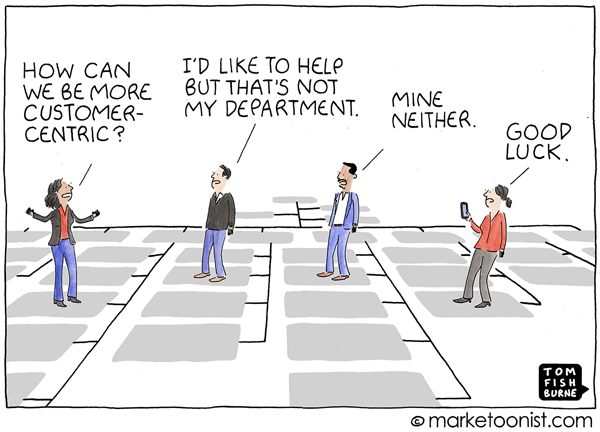
2020 November 6 MarketingCharts Chart Both B2B Marketers and Buyers Increasingly Sold on Conversational Marketing B2B marketing professionals have found email, online live chat, social media, and chatbots have all seen increased usage in 2020, while phone and video call use has fallen by more than 10 percent, according to recently-released B2B buyer communication survey data of interest to digital marketers. MarketingCharts B2B Tech Firms Cut Marketing Budgets Due To Pandemic: Study Despite an overall drop in marketing spending due to the global health crisis, budgeting for digital and content marketing are the most likely to see increased spending, while some 60 percent of B2B technology firm executives say that their key performance indicators (KPIs) haven't undergone change. MediaPost Subject Matter Expertise A Growing Factor for B2B Buyers When Evaluating Vendors In 2020 over 32 percent of B2B and professional services buyers see subject matter expertise and industry knowledge as the top attribute when evaluating firms, a rate over 11 percent higher than 2018 figures, with client service flexibility the only other element that became more important during the past two years — two of several statistics of interest to online marketers in recently-released survey data. MarketingCharts 7 ways COVID-19 has changed B2B customer experience forever The pandemic has blurred the lines between B2B and B2C marketing, brought more intelligent automation to customer experience (CX), and made trust a more important factor, and Adobe has taken a look at how these changes will play out in 2021 and beyond. Adobe (client) Linked Rolls Out Company Engagement Report LinkedIn (client) has launched a Company Engagement Report offering new insights for B2B marketers, especially those using account based marketing (ABM), featuring a variety of organic and ad engagement metrics, the Microsoft-owned professional social platform recently announced. Adweek Facebook Once Again Experiments with Up and Down Votes for Comments to Optimize Engagement Facebook has begun limited testing of Reddit-like upvoting and downvoting options among certain Facebook Groups, with an eye towards boosting relevant content and engagement levels, recent observations of the social media giant have shown. Social Media Today 2020 November 6 Statistics Image Google's Working on a New Process Which Would Convert Static Website Assets into Video Content Google has launched URL2Video, a new prototype utility that incorporates some of Google’s AI systems to turn static website digital assets into video content, in a move that could lead to new digital marketing opportunities, the search giant recently announced. Social Media Today Social Media Trends 2021 Global Report Content remixing, memetic media, and nostalgia marketing are among the trends marketers are likely to see more of during 2021, according to recently-released global social media survey trend data from HubSpot and Talkwalker. Talkwalker Microsoft Clarity, the company’s tool for visualizing user experience, is out of beta Microsoft has widely released Clarity, a free service offering a variety of user engagement and other metrics using site JavaScript, previously available only in beta form, the firm recently announced. Marketing Land B2B Content Marketers Getting More Successful in Building Credibility B2B content marketers say they have found creating brand awareness, educating audiences, and building credibility and trust as the top three benefits of B2B content marketing over the past year, followed by lead generation and building loyalty with existing customers, according to recently-released survey data of interest to digital marketers. MarketingCharts ON THE LIGHTER SIDE: 2020 November 6 Marketoonist Comic A lighthearted look at “CX is more than a department” by Marketoonist Tom Fishburne — Marketoonist New Photo Filter Shows What You Would Look Like in Facial-Recognition Database — The Hard Times/a> TOPRANK MARKETING & CLIENTS IN THE NEWS:
  • Lee Odden — #TimTalk - The Business of B2B Influence with Lee Odden — Timothy Hughes
  • Lane R. Ellis — 10 Tips for Prioritizing Tasks to Make the Most of Limited Small Business Resources — Small Business Trends
  • Lee Odden — 40 Marketing Quotes to Provoke Thought and Inspire — Visitor Queue
Have you found your own top B2B marketing stories from the past week of industry news? Please let us know in the comments below. Thanks for taking the time to join us for our weekly B2B marketing news, and we hope that you'll return again next Friday for another examination of the most relevant B2B and digital marketing industry news. In the meantime, you can follow us at @toprank on Twitter for even more timely daily news.

The post B2B Marketing News: B2B Content Marketing Credibility Study, LinkedIn’s New Company Engagement Report, Global Social Trends & Microsoft’s Free UX Tool appeared first on B2B Marketing Blog - TopRank®.


Article Source: http://bathseoexpert.blogspot.com/2020/11/b2b-marketing-news-b2b-content.html

Thursday, 5 November 2020

LinkedIn’s Ty Heath: 3 Enduring B2B Marketing Trends #MPB2B

Woman at computers looking at trend data image.

Woman at computers looking at trend data image. While MarketingProfs B2B Forum's Ann Handley was introducing Ty Heath, director of market engagement at The B2B Institute at LinkedIn*, for her keynote, “Evolve your Strategy: 3 Mega Marketing Trends to Outperform Your Competition,” she shared that one of the advantages of holding the event virtually for the first time was that you could be three places at once by being able to watch all sessions once the conference concludes. 2020 marked Ty’s third year speaking at #MPB2B, and her first keynoting the event, and for the occasion Ann shared her hand-drawn portrait of Ty. Ty Heath Screenshot A Ty began by explaining that LinkedIn’s B2B Institute serves as a think tank for accelerating B2B marketing and creating more value for B2B marketers, and then started her exploration of the three big trends that won't necessarily change over time — trends savvy marketers will want to invest in over the next decade in order to see their organizations thrive. A key point prefacing her three major trends was that marketers shouldn’t ask what everyone else is doing, but instead should be asking about what nobody is doing, and the importance of both doing what nobody else is and — equally important — being right about it. B2B marketing is largely a long-term game, Ty explained, noting that the three trends she would focus on during her #MPB2B presentation came from a robust collection of some 30 marketing trends that LinkedIn has researched over the past five years, available in report form in “2030 B2B Trends: Contrarian Ideas For The Next Decade.” Let’s take a look at the three mega-marketing trends Ty explored in her insightful MarketingProfs B2B Forum #MPB2B 2020 session.

Trend #1 — The War on Brand

Ty shared the importance of B2B marketers striking just the right balance of short-term activation versus long term branding, pointing out that one of brand-building's truest strengths is its effect on long term sales. While it often takes six months to begin seeing the effects of a B2B brand campaign, only a paltry four percent even measure beyond the six month mark, Ty explained, pointing out that smart B2B brands should be investing at least 50 percent on branding initiatives. Ty noted that in today’s B2B landscape, more buyers are doing their own research, but only on the brands that they've heard of. Branding can do so much more than activation alone can, Ty explained, including:
  • Delivering better short-term results
  • Increasing sales from future customers
  • Using brand investment's powers to raise prices
  • Acquiring and retaining the best talent
Ty took a look at the traditional sales funnel and shared how LinkedIn has benefited by flipping it sideways, allowing for observations of growth over time and a better visual understanding of in-market and out of market buyers.

Trend #2 — Blockbuster Marketing

Ty explored the power of creative effectiveness, using several film examples from Disney. Creativity isn't some magical state that exists off by itself, Ty said, however there are some general creativity principles that can work in more general terms. One tenet of blockbuster B2B marketing is betting big, as small bets are inherently risky, while big bets can be very profitable, Ty noted, showing examples of the dramatic differences in return from a variety of Disney films. Why are big bets more profitable? One reason is our attention spans, Ty observed, noting that big bets can be among the only ways that brands can break through today. Another is the role of familiarity, pointing to the success of movie sequels, and the fact that these are stories we know and are comfortable connecting with. Since at least 2015, Salesforce has used its "State of Sales" initiative to successfully build on familiarity through tactics such as reinvesting in existing creative and updating reports with new data to stay connected and keep these campaigns fresh, Ty explained. B2B marketers should also focus on the consistent distinctiveness of their efforts, Ty noted, with a unique look and feel that has been built and invested in over time. "Look like yourself and no one else," Ty urged, by using a logo, colors, and visual elements in advertisements that are recognizable. She also pointed out the power of total merchandising, by bringing the same creative to different channels, and used the successful Star Wars franchise — with its $33 billion galaxy of revenue — as an example. B2B marketers are well-served by making creative ideas into extensions of the franchise, Ty explained, such as by using total merchandising and through using the same creative in both online and traditional efforts, with each piece building on the last.

Trend #3 — The Death of Hyper-Targeting

There has been a major change in distribution effectiveness, as over the last decade B2B marketers have become obsessed with hyper-targeting using laser-like precision, Ty noted. This move to narrowly target tiny audiences has been taken to an extreme and has swung too far in that direction, Ty noted, explaining that "We've gone way overboard in the direction of hyper-targeting." This isn’t to say that account-based marketing (ABM) no longer has a place, she noted, suggesting that it still has a place in complementing an overall plan. In B2B it’s important to go broad, but not too broad, Ty observed, and then took a look at relevant reach and why it matters, suggesting that marketers also read LinkedIn's “5 Principles Of Growth In B2B Marketing” report. Reach is just as important in B2B as it is in B2C, depending on your competition, Ty noted, and used the example of Occam's razor — the thirteenth-century philosopher’s principle that entities should not be multiplied unnecessarily — to reinforce that in marketing, reach equals growth. A very real problem that arises with hyper-targeting is that it is sometimes — perhaps more often than we might expect — based on assumptions, which can lead to dangerous marketing problems, Ty noted. Such unsafe assumptions often include inaccurate data, and Ty shared a personal example of several websites she used that attempt to find demographic information from web browsing history data, each missing the target wildly in her case, with much incorrect data. Another peril B2B marketers face is assuming that we know precisely who to target, Ty observed, and suggested that we don't often know, but that we should let smart systems start to help us predict where we're going to get the best value. Hyper-targeting is usually more expensive while broad targeting can be more efficient, and the better value, and Ty noted that “Category reach is the most important thing." Wrapping up her insightful presentation, Ty urged B2B marketers to invest in brand building and in creating blockbuster franchises, and ended by asking “What's your share of voice? How does that compare with your market share, and how can you apply these three big trends?” In the post-session question and answer period, Ty expanded on methods for computing a share of voice (SOV) measurement, a metric she believes is greatly underrated and which can be quite telling, and which can also successfully be used to make the case for investment. Ty Heath Screenshot 2 Ty also expanded on the merchandising concepts she'd mentioned earlier in her presentation, noting that it’s an area where B2C marketers do an especially good job, and she urged B2B marketers to take stock of where their assets lie and to work towards building fame, uniqueness, and the other elements that make your brand special. Be sure to check out our additional #MPB2B 2020 coverage listed below: * LinkedIn is a TopRank Marketing client.

The post LinkedIn’s Ty Heath: 3 Enduring B2B Marketing Trends #MPB2B appeared first on B2B Marketing Blog - TopRank®.


Article Source: http://bathseoexpert.blogspot.com/2020/11/linkedins-ty-heath-3-enduring-b2b.html

Wednesday, 4 November 2020

HigherVisibility Wins Two SEO Agency of the Year Awards in 2020

SEO

The accolades from Search Engine Land and the US Search Awards cap off a banner year.

HigherVisibility was presented with two SEO Agency of the Year awards in the month of October:

The awards are judged by industry professionals and peers and highlight the most successful companies and campaigns in the SEO industry.

“Winning the most respected awards in our industry during such a uniquely challenging time is a testament to the hard work that our team puts in for our clients,” Managing Partner Scott Langdon said. “We couldn’t be more proud of our staff and we are thankful for the clients that have put their faith in us.”

The US Search Awards featured a vast panel of judges to peer review the finalists for their awards. HigherVisibility beat out a shortlist of six other finalists to win the award. Kevin Gibbons, the CEO at Re: signal and the judge presenting the award, cited HigherVisibility’s “great results, both for clients and in their own growth” as the reasons for our victory.

Search Engine Land’s panel of judges included many of their top in-house editors, as well as a group of marketing professionals specializing in a variety of fields. The Search Engine Land Awards – coined as Search Marketing’s Highest Honors – celebrate those within the search marketing community who have achieved excellence in their organic and paid search campaigns as well as overall research.

This is not the first time that HigherVisibility has been named SEO Agency of the Year by Search Engine Land; we also won the award in 2017, making us two-time winners of the award.

The post HigherVisibility Wins Two SEO Agency of the Year Awards in 2020 appeared first on HigherVisibility.


The post https://www.highervisibility.com/blog/highervisibility-wins-two-seo-agency-of-the-year-awards-in-2020/ appeared first on https://www.highervisibility.com

Adobe’s Rani Mani: 5 Tips For Creating Your B2B Influencer Marketing Love Affair #MPB2B

Woman making heart sign with her hands image.

Woman making heart sign with her hands image. Rani Mani, head of global employee advocacy at Adobe* delivered an impassioned presentation filled to the brim with B2B influencer marketing insights, with a special focus on how the best influencer relationships are in essence not that different from successful personal relationships. Rani explained how she’s come to have a love affair with influencer marketing, and shared the process she uses to help turn mere social media heavyweights into long-term and deeply-engaged Adobe advocates — a plan than can be implemented by any brand willing to put in the time, effort, and especially the passion that Rani and her team have. When it comes to the domain experts Adobe is leveraging for the good of the brand, there isn’t any magic involved — no algorithm or gimmicks to beat the system — instead simply leveraging the power of humanity within B2B marketing influencer relationships, just as we do in successful real life relationships, Rani explained. Now let's jump right in with the five top tips I took away from attending Rani's insightful MarketingProfs B2B Forum #MPB2B 2020 session, "Influencer Love Affair: Dating With an Eye Towards Long-Term Commitment, Not One-Night Stands."

1 — Building Sustainable B2B Influencer Relationships

Rani examined how building sustainable influencer relationships involves a journey through the funnel, from being generally unaware about your brand to obtaining a certain level of awareness, and then moving on to genuine interest, ultimately followed by engagement, connection, and becoming powerful and loyal brand advocates. Rani suggested working with influencers towards a goal of making the conversion from being unaware to passionate advocates for the brand, at which point they can become active and important parts of a brand’s strategy. Many of the best practices that Rani shared are equally adept in the oftentimes different worlds of B2B and B2C, she noted, sharing an "Influencer Mantra" theme she has used for Adobe. The mantra focuses on how building new B2B influencer relationships can benefit from some of the similarities with dating, with an eye toward long-term commitment and engagement, while also recognizing that not all influencers want to be involved in long-term commitments.

2 — Starting Out With Long-Term Influencer Programs

How do successful long-term influencer relationships begin? Many times they start with saying “thank you,” Rani suggested, coming in the form of a physical hand-written card sent through the mail system, or via e-mail or a public social media post. Whatever form these thank you messages take, influencers should be addressed by name, and thanked individually for what they've done for you or your brand. Holidays provide additional opportunities to thank influencers with gifts, which Adobe uses to help show just how special their influencers are, Rani noted. When posted publicly on social media, expressions of influencer thanks and appreciation can be powerful messages that other brands will often see. Thanking your existing or potential B2B influencers can also come in the form of a LinkedIn* endorsement, and can even involve referring them for additional influencer work at partner brands.

3 — Investing Time Upfront Pays Off With Lasting Influencer Relationships

A big part of any lasting relationship is when we each learn about one another, and Rani explained how it’s no different in B2B influencer marketing, where savvy brands will genuinely want to find out what makes the heart of a particular influencer sing? It’s important to put in the time to develop strong and enduring influencer relationships, Rani noted. As in any relationship, learning who an influencer really is requires time, and speed-dating just doesn't work, as strong relationships don't happen overnight. Learn about influencers by asking thoughtful questions to learn their passions and topics of interest, and this can be accomplished adeptly by asking open-ended questions such as “Where do you want to go, and what do you want to do?” Rani suggested. Then comes the time to perform the match-making part of the influencer marketing equation, by putting the knowledge you’ve gained about an influencer to use in connecting with the most relevant campaigns, brands, brand partners, or with other similar influencers. Rani also urged a share-the-mic approach when it comes to leveraging brand equity to build, grow, and help influencers.

4 — Meaningful Connections Are Still Vital & Possible Virtually

While face-to-face meetings may be on hold, their power shouldn’t be underestimated according to Rani, who shared several ways we can still connect virtually with influencers, including at Adobe’s upcoming Adobe MAX 2020 conference. At this and other events Adobe works to create very special experiences for their influencers, including:
  • Exclusive influencer summits
  • Event pre-briefings
  • Sneak-peeks into embargoed programs
  • Special forums asking for feedback
These help us learn what an influencer’s community of social media followers and fans are saying, and to find out what an influencer would do in a particular situation — all valuable information. In-person events allow for a variety of fun things that can greatly enhance camaraderie, such as at an AdWeek event Rani mentioned during which Adobe hosted a cooking extravaganza for their influencers. All of these are designed to be fun and provide a low-key way to relax and connect on a very real human level, Rani shared, recalling the time Adobe’s influencers went to NASDAQ and each had time on NASDAQ TV to share their predictions. The influencers were happy to promote this on their own channels, and Adobe was able to as well, all combining to further build the brand fan base. Bringing influencers to a company’s headquarters for briefings, tours, meetings with corporate management and other on-site activities can also be a great way to strengthen influencer relationships, Rani shared. During the pandemic this can all be creatively done in our new virtual landscape, Rani suggested, stressing the importance of going out of your way to make these types of connections, even if it’s as simple as getting on the phone for an hour, a Zoom meeting or happy hour, or an online group chat. Rani brought up Adobe’s especially active influencer direct-message Twitter group, a special forum she has found to be quite heartwarming, with influencers acting as trusted advisors for one another.

5 — Good Judgement Tops Any Algorithm

via GIPHY "Good judgement will always beat an algorithm," Rani said, while also noting that a smart influencer marketing program will need a certain amount of numerical and other data to help select the right cultural fit for an influencer, but that it’s even more powerful to understand that influencers are humans and not merely the sum of their various social media numbers. Rani urged B2B marketers to learn about influencers the way you would if you were checking on a potential soul-mate. How would you select someone for yourself, for a friend, or for your own family to date? In addition to audience number data, it’s important to look at the authority level of their audience, and to take the time and effort to filter this information from a personal and human level to understand the influencer’s cultural and overall makeup. Rani ended her insightful presentation with a famous Salvador Dali quote, “Have no fear of perfection — you'll never reach it,” and noted that while there will be disagreements with influencers, by having a long-term and mutually-respectful relationship, you’ll be able to honestly share such issues and work through them together. Finally, during the post-session question and answer period, Rani shared some of the key performance indicator (KPI) elements often used for measuring success, but suggested that these always varies from campaign to campaign, and can include KPIs such as social volume, retention, sales, or pure engagement. The ultimate KPI of an influencer having your back is both priceless and unquantifiable, however, Rani noted, offering examples of how Adobe’s influencers have been powerful allies when it comes to providing crisis management, as they are often the first to defend a brand. In today’s virtual environment, influencer connection requires a bit more ingenuity and effort but accomplishes the same things as during pre-pandemic times, Rani observed, noting that we should keep in mind that the key tactics haven't changed, and we shouldn’t use the current times as an excuse to not be human. Be sure to check out our additional #MPB2B 2020 coverage listed below, and don't miss our CEO Lee Odden's session “New Research: How to be Successful With Influencer Marketing” on Thursday, November 5th at 12:55 p.m. Eastern. *Adobe and LinkedIn are  TopRank Marketing clients.

The post Adobe’s Rani Mani: 5 Tips For Creating Your B2B Influencer Marketing Love Affair #MPB2B appeared first on B2B Marketing Blog - TopRank®.


Article Source: http://bathseoexpert.blogspot.com/2020/11/adobes-rani-mani-5-tips-for-creating.html