Wednesday, 24 March 2021

Choosing The Best B2B Influencers Is Key To Success — Here’s Why

Professional woman holding yes and no signs image.

Professional woman holding yes and no signs image. Why is it important to find the right B2B influencers? Are there right and wrong ways to approach the process of choosing the best B2B influencers? The crucial task of selecting B2B influencers who will drive the greatest success for a brand isn’t a simple one, yet it’s one often shrouded in mystery — a question that we’ll explore utilizing a collection of do’s and don’ts. There is no single more important element in B2B influencer marketing than finding subject matter experts who will provide the best relevance, resonance, and engagement for your brand. Join in as we take a look at what a smart B2B influencer selection process looks like, and why some approaches are better than others. If you're wonderful why influencer marketing is a winning solution for B2B brands, also be sure to check out our recent "Why Influencer Marketing Should Be a Priority 2021 Tactic for B2B Brands." [bctt tweet="“There is no single more important element in B2B influencer marketing than finding subject matter experts who will provide the best relevance, resonance, and engagement for your brand.” — Lane R. Ellis @lanerellis" username="toprank"]

Don’t — Rely Solely On Follower Counts

Mere follower count tallies tell only a partial tale when it comes to whether an influencer’s audience is first and foremost authentic — and not filled with fake accounts and the like — along with being topically relevant to the issues that are important to a brand. A potential influencer’s follower count plays a role in the selection process, certainly, however learning whether an industry expert’s followers are actively engaging with them by posting, commenting or by utilizing other forms of social sharing is usually a more important element when it comes to finding ideal influencers. This type of follower analysis requires a deeper variety of research into whether a potential influencer will likely be a good brand match, and as we’ll explore, it requires both taking full advantage of powerful tools for measuring social media engagement as well as a human touch. As our CEO and co-founder Lee Odden has shared with audiences since the dawn of B2B influencer marketing, in the B2B world you actually have to be an expert to be a great influencer — you can’t just be good at making videos, tweeting, or other individual particular forms of social messaging, as is often the case in B2C.

Do — Measure Follower Relevance, Resonance & Engagement

As we’ll explore, there are numerous helpful tools and platforms that help to a certain extent in the process of finding the best influencers for a particular brand, however their numerical measurements and rankings are only able to do so much, and often work best when several tools are used and then combined and analyzed by a competent B2B influencer marketing researcher. It’s key to look at a potential influencer’s topical relevance, and their resonance — the degree to which that topic resonates with the audience network of a particular influencer. [bctt tweet="“There are numerous helpful tools and platforms that help to a certain extent in the process of finding the best influencers for a particular brand, however their numerical measurements and rankings are only able to do so much.” @lanerellis" username="toprank"]

Don’t — Take A B2C Influencer Approach For Reaching B2B Audiences

B2C influencer marketing’s traditional approach, often built on paid relationships with minor or major celebrities — while occasionally utilized in B2B marketing — typically isn’t well-suited to creating the kind of expert credibility that B2B buyers and customers are seeking. Instead, smart B2B marketers use an influencer selection process that heavily relies on locating the most relevant subject matter experts for a particular topic — professionals who may be famous only on a certain niche industry Reddit channel or other social media platform. Their form of celebrity, however — while on the micro side — resonates well with B2B buyers, as the fame a good B2B influencer has built is based on genuine expertise about a topic. As Lee has explained over the years, if you want the best influencer content, invite the scientist, engineer, educator, or academic to share their perspective. When they do this as an influencer, it’s going to lift the quality of your brand’s content and help make it great. Simply seeking true celebrities for influencer marketing and hoping for massive engagement offers very little return on investment in the B2B arena, where influence has reached a level of democratization. This presents new opportunities for influencers, and makes the process of finding the right influencer more challenging than ever, despite having what may be a bigger pool of influencer talent than ever to work with. As Lee and others have suggested, smart brands will find B2B influencers that help them go for a little bit from a lot of different people in an important niche, where the micro-influencer approach has increasingly become more relevant as a way to build advocacy and co-create content in a way that speaks closely to the voice of the customer.

Do — Recognize B2B Brands’ Unique Influencer Challenges

The process of selecting the best influencer matches for B2B marketing should include substantial recognition of the nature of B2B influencer marketing, with its unique challenges such as significantly longer buying cycles than in B2C, while also being aware of the opportunities that are unique to B2B influencer marketing. There’s little doubt that today’s B2B buyers are overwhelmed with options, and that they have often grown distrustful of marketing and advertising, which has increased the power of influencers, who are expert sources of trusted information. Choosing the right B2B influencers leads to the creation of credible connections with people who are actively interested in paying attention. B2B’s longer sales cycles result in vast amounts of content being created to help buyers learn, and the research they do is increasingly self-directed, so unlike in traditional B2C influencer marketing, B2B influencers must have the credibility to influence others. When you've successfully found the best B2B influencers, you generally have people who are truly invested in improving their industry in the long run, so taking the extra time and performing the additional steps to discover and vet them are costs that are usually well spent.

Don’t — Settle For An Automated Generic Approach

We’ve touched on some of the tools and platforms available to help marketers find potential influencers — utilities such as Traackr, Onalytica, BuzzSumo, and dozens of others — and why even when combined, the numerical rankings such services can deliver will only take you so far in your journey to find the best B2B influencers. As Lee has noted in his various presentations on B2B influencer marketing, it’s important to utilize software during this stage — tools that can crawl millions of social messages and algorithmically identify the people who have a particular combination of reach, network size, popularity — but more importantly — the topical relevance that shows that a potential influencer is indeed publishing content on the topic that you as a brand want to be the best answer for.

Do — Use A Human Touch To Refine Tool & Platform Recommendations

Perhaps the single most important work in finding truly the best influencers for a B2B brand takes place once the apps have been utilized, the platforms have been thoroughly put through their paces, and the social tools have crunched their final numbers — this is when the human touch begins, and takes the B2B influencer selection process to an entirely different level of success. Using platforms and social tools, successful B2B marketers can have piles of data on potential influencers to work with, but what sets apart the best plan from the rest is when a professional familiar with every facet of B2B influencer marketing methodically assesses that data as just one piece of the digital tapestry of successful B2B influencer marketing success. A cohesive approach to the B2B influencer selection combines the best data available about potential influencers with a human touch that includes such elements as:
  • Staying True to a Brand’s Mission
  • Weeding Out Irrelevant Data
  • Prioritizing the Best Data
  • Moving Influencer Recommendations into Solid Strategy
Other human-powered elements that go well beyond influencer research platforms and tools include the use search, customer relationship management (CRM), and social data relating not only to potential influencers but to a brand’s mission, to get an understanding of what it is that people are thinking about relevant to the brand and their customer connections. This type of information can help uncover intersections of topics that can be factored in when selecting the best influencers for a particular brand. [bctt tweet="“The best plans use a professional familiar with every facet of B2B influencer marketing to methodically assesses data as just one piece of the digital tapestry of successful B2B influencer marketing success.” — Lane R. Ellis @lanerellis" username="toprank"]

Don’t — Use Only A One-Off Approach

A short-term approach to B2B influencer marketing isn’t well-suited to activating the unique power that the top B2B influencers have to deliver stellar results to brands. One-off B2B influencer campaigns are akin to merely borrowing influence by working with top industry experts, and when that’s the extent of a brand’s commitment, they’re not going to reap the full value and the many benefits of influencer marketing. As Lee has noted, when you take a short term approach, you’re also typically not going to form the type of ongoing emotional connections with influencers that are central to an always-on approach to B2B influencer marketing. Countering the short-term variety of B2B influencer marketing is always-on influence, which succeeds in part because buyers are always on, and our digital world of today certainly also is.

Do — Utilize The Power of Always-On Influencers

When choosing B2B influencers, be cognizant of the advantages of an always-on strategy, which thrives in making the type of lifelong commitment to clients and customers that creates avid fans. Despite its advantages, just 19 percent of B2B marketers are running ongoing influencer marketing programs, research from our State of B2B Influencer Marketing Report shows. Among the many reasons why ongoing B2B influencer marketing programs are successful, the following insights from our research help reinforce the point:
  • 60 percent of marketers who use always-on influencer marketing programs are very successful versus 5 percent who do periodic campaigns
  • 12 times more marketers are very successful when they run an always-on influencer program versus those who opt for periodic campaigns
  • 89 percent of B2B marketers who use an always-on approach expect their budgets to increase or remain the same in the next 12 months
  • 94 percent say that influencer marketing will grow in importance over the next 12 months
  • 75 percent saw an increase in their views of brand content using an always-on approach
The process of finding and selecting the right B2B influencers benefits when right from the beginning it’s understood that an always-on approach to influencer marketing will be used. Among the human elements that go beyond prospective influencer ranking data to find the best influencers is an understanding of whether the relationships between brands and influencers will be short-lived or one that will stand the test of time. A healthy selection process takes this into consideration, along with all of the other influencer research elements we’ve touched on.

Say ‘I Do’ To A Best-Answer Influencer Search

via GIPHY By knowing what not to do when it comes to finding and selecting the best B2B influencer matches, saying “I do!” to the right ones suddenly becomes much more straightforward. We hope that the insights we've explored here will help inform your own B2B influencer selection strategy. More B2B brands than ever are turning to a dedicated specialist B2B influencer marketing agency such as TopRank Marketing, which has worked with brands from Adobe, LinkedIn, and SAP to 3M, Dell, Oracle and many more. Our research shows that 60 percent of marketers don’t have the right in-house skills or knowledge to execute an influencer marketing program. Learn how to begin an influencer marketing pilot program or start a full-featured always-on influencer program.

The post Choosing The Best B2B Influencers Is Key To Success — Here’s Why appeared first on B2B Marketing Blog - TopRank®.


Article Source: http://bathseoexpert.blogspot.com/2021/03/choosing-best-b2b-influencers-is-key-to.html

Tuesday, 23 March 2021

How B2B Marketing Influencers Are Finding Success On New Social Channels

Woman showing phone screen image.

Woman showing phone screen image. In the world of social media, the only constant is change. Each platform continues to update and add new features, and new channels appear on a regular basis. With this change comes opportunities for B2B marketing influencers to share their thought leadership in new ways and have their voices heard. I tapped top B2B influencers and thought leaders to see where they are finding successes on some of the newer social channels. Come along and let's explore the social media maze with them.

Finding Business in the Clubhouse

If you are jumping on trends, don’t miss getting an invite to the audio-only Clubhouse app. TopRank Marketing CEO Lee Odden noted “audio and voice will continue to be a trend for information discovery, consumption and engagement in 2021.” One of the key reasons to be on Clubhouse is to gain followers, and not just in that app, but also on other channels. Industry veteran Dennis Yu documented his first day on the app with key insights into how he gained 650 followers in one day. Stephanie Thum Stephanie Thum, founding principal at Practical CX has also successfully built connections through Clubhouse. “Participating on the Clubhouse app immediately increased my social and professional networks. Clubhouse is amazing for the give-and-take communication and information exchange,” Stephanie said. Mark Schaefer Mark Schaefer, chief operating officer at BSquared Media agrees. “I am seeing a ton of B2B marketers on this platform simply to connect, exchange ideas, and network. I've made many new connections through conversations on Clubhouse that lead to new LinkedIn relationships.” Ivana Taylor The invite-only nature of Clubhouse can make it feel limiting, however. Ivana Taylor, marketing strategist at DIY Marketing commented, “I’m looking forward to when more of my friends join so we can all be together.” Brian Fanzo Success can be measured in many ways, but adding to the bottom line is at the top of the list. Brian Fanzo, digital futurist and professional speaker at iSocialFanz, says he’s gotten business from Clubhouse. “A brand heard me, and now I am doing a speaking gig for them.” Clubhouse is also time consuming. In order to dedicate the time he needed to develop his presence on Clubhouse, Brian learned to lean more on his team and delegate more responsibilities. “Clubhouse is an interesting place for connection and inspiration, but in the short-term pretty limited in terms of customer communications and content creation for the B2B professional,” Mark added, “But it is evolving rapidly, and it's definitely worth exploration.”

Twitter Spaces Taking on the Challenge

Twitter rolled-out it’s new audio-only tool, too — Twitter Spaces. If you don’t have it yet, you are not alone, as it is only for iOS, but rolling out to Android soon. Android users can join and participate in Spaces on the Twitter app, they just can’t start one. When describing the difference between Spaces and Clubhouse, Brian says, “Clubhouse is like a conference. Spaces is like a dinner party.” One big difference is in the reactions to your speech or discussion, as Twitter let’s you react either to everyone in the space personally, or to the whole group. Moderators can also tweet additional information via direct tweets to the space, to allow the group to gain additional context. “These apps are a gateway drug to social storytelling,” Brain noted when hosting a Spaces room to discuss both apps. If you follow the #TwitterSmarter weekly Twitter chat, you may have checked out the after party on Spaces with host and social media speaker and consultant Madalyn Skar. On her blog, Madalyn shared a Beta tester’s success story of how she increased her following by 769%, and how as a plus, they were all authentic followers. Twitter Spaces also offers another key advantage to the B2B marketer – branding. Spaces is a great place for you to establish your brand to a larger audience or in a one-to-one setting.

Boosting with Fleets on Twitter

The popularity of the story format has now come to both Twitter and LinkedIn. Twitter’s version of stories can help to boost the presence of any thought leader. This newish tool is only visible on mobile, just like Spaces. Recently, I noticed a tweet Stephanie posted for our client Mitel significantly outperformed many of her other posts. She commented, “Right?! That one Tweet went wild! I have a totally unsubstantiated theory that all of the posts got more impressions this time because of Twitter Fleets and Clubhouse.” She accomplished that by reposting the tweet in a Fleet.

Exploring Other Channels

A few months ago, I noticed that MeWe was making a resurgence. In musing about it, a B2B influencer asked me for more information, so I sent her an invite to go exploring with me. It is not currently a big B2B platform, but one to be aware of, along with Ello. Shonali Burke “In terms of new platforms, there's no shortage of them; I'm even seeing some older platforms show up in my stream (such as Ello),” says Shonoli Burke, president and CEO of Shonali Burke Consulting. She continues, “For me, that points to two elements marketers really need to be thinking about: first, if you're going to blast the same content out via different platforms via cross-publishing, you run the risk of generalizing your content to the point where it loses impact. How much attention are you actually paying to the specific audience for that platform? Aren't you actually contributing to the noise, and actually reducing the potential to reach what *should* be a specific audience?” “And the second follows from the first: *why* are you on that platform anyway? Are you on TikTok because it's the shiny new toy du jour, or because you're trying to reach Gen Z for very specific reasons? And does it make sense for *your* specific type of organization? What's the strategy here?” she added.

Finding Success on Social Channels

B2B influencers are finding success on many of these new platforms, but the key is time and finding the right audience. As these channels grow and change, we as marketers should challenge ourselves to join influencers in the exploration of these new spaces. What is your favorite new social channel and why? We would like to hear about your experience.

The post How B2B Marketing Influencers Are Finding Success On New Social Channels appeared first on B2B Marketing Blog - TopRank®.


Article Source: http://bathseoexpert.blogspot.com/2021/03/how-b2b-marketing-influencers-are.html

Monday, 22 March 2021

20 Ways to Build B2B Executive Credibility and Thought Leadership

B2B thought leadership

B2B thought leadership The pandemic driven digital transformation of B2B marketing to digital first has created all new levels of competition for time, attention and trust. In this environment, the importance of building credibility and trust is essential in order to deliver stand out customer experiences. But how? B2B brand Thought Leadership certainly plays a role and as the trends in trust focus more on individuals over companies, the opportunity to optimize content experiences through executive thought leadership and influence are growing. The more influence B2B brand executives have, the more credibility the brand has. But how? How can B2B marketers build awareness, credibility and influence of their key executives with content? Here are a few tried and true tactics that continue to work in today's digital B2B environment:
  • Client Testimonials – The customer success story is often one of the first things that catches the eye when looking at potential vendors. Common mistakes include testimonials that are too enthusiastic or those that are benign but packed as if they’re something special. Testimonials should reflect issues of interest to the target audience and also include supporting quotes from key B2B brand executives.
  • Case Studies – For deeper consideration, B2B brands want to drill down into the specifics of how a company does what it does and the results achieved. Case studies present a picture of a company’s breadth and depth of ability to solve a variety of issues and insights about the story from key B2B executives adds credibility to the study and to the brand.
  • Industry Awards – Getting recognized by a respected third party can mean a quick trip to the credibility club. However, such awards are only as meaningful as the credibility of the entities giving them out. Whether a B2B brand is receiving or giving out the awards, key executive should be involved and cited.
  • Being Quoted by the Press, Blogs – Being cited as an authority on a particular topic in a high profile publication can be instrumental for building a key executives reputation and credibility and by proxy, the trust and influence of the brand. Relevant media pickups should be curated on the brand's newsroom or on brand social which is another opportunity to highlight relevant brand executives.
  • Influencing the Influencers – It has become a universal truth that buyers trust people more than brands. As a result, there is a significant growth in influencers within various B2B industries. B2B brands can tap into influence by collaborating with individuals that have the trust and attention of customers as well as by building the influence of existing employees. Influencer status could be a consideration when making certain new hire decisions as well.
  • Speaking at Industry Events – While most events in the B2B world are now virtual, there are more of them, which presents a great opportunity for key B2B executives to showcase their individual expertise as well as the thought leadership of the brand. Not everyone gets to start out giving keynotes, so be prepared to do some breakouts and work up the ladder of speaker status.
  • Representation on the Brand Web Site– A web site still says a lot about a company and the leadership. Social proof of thought leadership for key executives gives a strong signal of credibility for their expertise and participation in the industry.
  • Editorial Contributions to Industry Publications – Contributing articles to prominent online or print publications gives companies an opportunity to show their unique problem solving abilities and expertise. By association with the publication, the B2B brand also gets a boost in the credibility department.
  • Advertising and Sponsored Content – One way of “buying your reputation” is to advertise in all the places your target audience looks for credible information. This takes a crack creative team and a healthy budget. Featuring key executives in sponsored content can send very strong signals of industry credibility.
  • Employee Advocacy – How employees talk on social networks and wherever they connect about relevant industry topics can have a significant impact on the perceived authority and credibility of brand executives. Fueling employee advocacy with brand information that may be useful to their own social engagement can create value for everyone involved.
  • Search Engine Visibility – When people search on topics relevant to your industry, your brand website and social channels should show up. But so should the content authored by the thought leaders at your brand. Formats can vary from text to video to audio. In many cases social conversations create interest, but findability in search creates trust.
  • Brand – Message  – There’s a lot that goes into creating a personal brand.  Each interaction between a prospective company and something that communicates information about the B2B brand is an opportunity to make a brand promise. Repeat interactions provide the opportunity to keep that promise. Thoughtful messaging and image also convey important messages that evoke feelings which can either build or detract from credibility for both the executive and the B2B brand.
  • Press Releases – Sending out press releases to wire services and directly to cultivated lists of relevant industry publications sends signals of your credibility. And with clever pitching, they might even get you some press coverage.
  • Social Media Footprint – Forums, Social Networks, Images, Videos, Podcasts – The boon in social networks usage by those in the B2B world gives abundant opportunity to see another side of a B2B brand. Forums can be very useful to connect helpful and knowledgeable executives with prospective customers and even the media looking for insights. Promoting unique knowledge through social media formats and networks can give important indications of a B2B executives expertise in formats that can match the information consumption preferences of a variety of potential clients.
  • Research Published – In the same way that faculty at Universities gain prominence and reputation by publishing research in professional journals, B2B brands that have the insight and resources to conduct real research and publish their findings create very strong signals of credibility. It is not only the execution of such research that makes it an effective “signal” though. The intelligent promotion by key executives of these learnings is as much or more important.
  • Industry Association Involvement – Investing in the future of the overall industry through association involvement by key executives and thought leaders can give the impression that a B2B brand has a higher level commitment than those that are not involved. Being involved with setting industry standards, guidelines and even training programs can set a B2B brand apart and give an indication of their expertise.
  • CEO, Executive and/or Company Blog – Blogs can still be effective at imparting a company’s philosophy and corporate personality. Company web sites tend to be dry and careful or conversely, full of hype. A well written and promoted blog can do amazing things for a B2B executive and brand's reputation in an industry.
  • Podcast and Social Audio –  Audio content is decidedly on the rise in B2B through an increase in the popularity of podcasts. Social audio through new platforms like Clubhouse and features of existing social platforms like Twitter Spaces creates an opportunity for B2B brand executives to showcase their expertise, network and engage a community.
  • Word on the Street, Buzz, Word of Mouth – First and foremost, doing good work is the cornerstone of building positive word of mouth. At the same time, successfully engaging the tactics on this list will build positive buzz, but the longevity of that buzz is only sustainable if the B2B executives involved deliver results. There is such a thing as over-marketing and people are smart enough to realize that one person can’t do everything. Making it easy for clients to pass on the good news or making sure testimonials are properly promoted can extend a B2b executive's reach with nominal marketing investment.
  • Being Included on Industry “Lists” – No matter how you slice and dice it, getting included on a list sends a signal. Lists are inherently controversial because getting included means others are excluded. If you know how to create and promote the right signals, like doing great work for clients and letting the world know about it, getting on the kinds of lists that build credibility is pretty straightforward. Alternatively, a B2B brand can make its own list and use a key executive to communicate the criteria. If you can't be king, be a kingmaker.
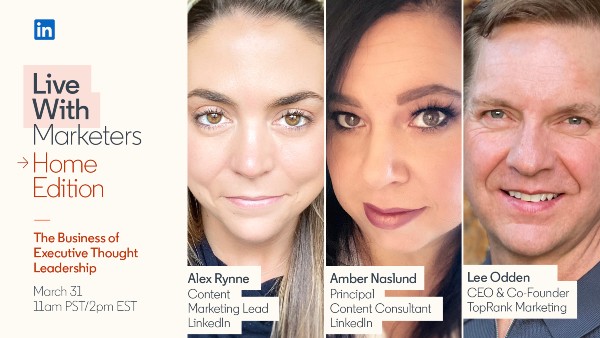
Executive Thought Leadership If you'd like to learn more about building B2B thought leadership with brand executives, be sure to tune in to the March 31st Edition of LinkedIn's Live with Marketers: The Business of Executive Thought Leadership featuring Alex Rynne and Amber Naslund from LinkedIn and myself as we cover:
  • What a compelling executive presence can do for your business
  • Examples of effective thought leadership on LinkedIn
  • How to measure your thought leadership efforts
  • How to create a compelling and engaging profile
  • How to integrate brand, executives and corporate communication
And more. Sign up here.

The post 20 Ways to Build B2B Executive Credibility and Thought Leadership appeared first on B2B Marketing Blog - TopRank®.


Article Source: http://bathseoexpert.blogspot.com/2021/03/20-ways-to-build-b2b-executive.html

Friday, 19 March 2021

B2B Marketing News: Livestreaming Use By Influencers Climbs, New Omnichannel B2B Report, LinkedIn’s New Campaign Worksheets, & Clubhouse’s Accelerator Program

2021 March 19 McKinsey and Company Chart

2021 March 19 McKinsey and Company Chart Longer Articles Associated with More Traffic, Shares Longer articles tend to get greater numbers of views and shares, with 7,000-plus word articles the most likely to be shared and garner the most page-views, according to recently-released SEMrush data examining some 1.2 million blog articles. MarketingCharts Gartner: 75% of VCs will use AI to make investment decisions by 2025 Study data looks at how shifting from gut-feel decisions to artificial intelligence-based investment has begun to affect venture capital, while moving from a pilot program to production is a top data science and machine learning challenge, newly-released report data shows. VentureBeat Livestreaming finds a home among influencers Live-stream content usage by influencers has remained steady during the pandemic, with some 37 percent of U.K. and U.S. social media users who follow influencers noting that they actively watched the live-stream influencer content, in surveys conducted both in May and September 2020, according to recently-released report data. eMarketer Hootsuite's Social Media Image Size Guide for 2021 [Infographic] Hootsuite has rolled out its latest annual information sheet featuring the latest recommended image size specifications for top social media platforms, the company recently announced. Social Media Today Almost Half of Adults Have A Negative View of Big Tech Between 2019 and 2021, the number of US adults who held a very negative view of technology companies more than doubled, from 10 percent to 22 percent, while those who took either a somewhat or very positive view of tech firms fell from 46 percent to 34 percent, according to recently-released Gallup data of interest to digital marketers. MarketingCharts LinkedIn Provides New Worksheets to Help Map Out Your On-Platform Ad Campaigns Microsoft-owned professional social media platform LinkedIn (client) has released a new selection of worksheets and guides offering digital marketers helpful information on currently available advertising campaign options for the platform, the firm recently announced. Social Media Today 2021 March 19 Statistics Image Hispanics Feel Brands Don't Understand Their Culture: Study 70 percent of U.S. Hispanics say that brands don’t understand the Hispanic culture, a figure that represents an increase from 59 percent in 2020, according to newly-released survey data. MediaPost Clubhouse Launches Creator Accelerator Program to Help Support Broadcasters in the App Rising audio-call-based communication iOS app Clubhouse has rolled out a new program aimed at helping selected broadcasters using the invitation-only platform by providing several resources, including financial support and sponsorship matching assistance, the company recently announced. Social Media Today Marketers Lack Skills Needed for Success, Scoring 36% on Digital IQ Test [Report] 58 percent of marketers failed to correctly answer social media marketing questions relating to LinkedIn, while some 33 percent incorrectly answered the questions regarding Instagram — two of several statistics of interest to digital marketers in newly-released survey data. Boot Camp Digital Omnichannel in B2B sales: The new normal in a year that has been anything but B2B buyers increasingly say that they want to communicate using a combination of in-person, remote, and eCommerce channels rather that a single communication channel, according to recently-released report data examining the role of omni-channel sales during the pandemic. McKinsey ON THE LIGHTER SIDE: 2021 March 19 Marketoonist Comic A lighthearted look at “brands on social media” by Marketoonist Tom Fishburne — Marketoonist The Buzzy, Chatty, Out-of-Control Rise of Clubhouse — Wired TOPRANK MARKETING & CLIENTS IN THE NEWS:
  • Lee Odden — B2B vs. B2C Influencer Marketing: The Single Biggest Difference — Webbiquity
Have you found your own key B2B marketing story from the past week of industry news? Please let us know in the comments below. Thank you for joining us for the TopRank Marketing B2B marketing news, and we hope you'll will return next Friday for more of the week's most relevant B2B and digital marketing industry news. In the meantime, you can follow us at @toprank on Twitter for even more timely daily news.

The post B2B Marketing News: Livestreaming Use By Influencers Climbs, New Omnichannel B2B Report, LinkedIn’s New Campaign Worksheets, & Clubhouse’s Accelerator Program appeared first on B2B Marketing Blog - TopRank®.


Article Source: http://bathseoexpert.blogspot.com/2021/03/b2b-marketing-news-livestreaming-use-by.html

Thursday, 18 March 2021

Break Free B2B Marketing: Nicole Brady of SAHM Reviews on the Importance of Empathy in Reaching Your Niche

Nicole Brady Image

Nicole Brady Image For over a decade our team at TopRank Marketing has fostered a strong community of leading influencers, developing close relationships with subject matter experts in a wide variety of industries. When it comes to B2B influencer marketing, it's natural to wonder just what an industry influencer actually looks like? In our third season of Break Free B2B Marketing video interviews, we’re continuing in-depth conversations with a selection of top B2B influencers, and taking a close look at the issues that each expert is influential about in their own industry. Each successful B2B influencer has a rare mix of the 5 Ps — proficiency, personality, publishing, promotion, and popularity — as our CEO Lee Odden has outlined in “5 Key Traits of the Best B2B Influencers.” Featuring all of these qualities and many more is Nicole Brady, publisher at SAHM Reviews, who we’re delighted to be profiling today. According to a study done by G2, 92% of B2B buyers are more likely to purchase after reading a trusted review. A different study tells us that 91% of customers between the ages of 18 and 34 trust online reviews just as much as they would a personal recommendation. Long story short: buyers care about reviews, whether they're a business or an individual consumer. Some people understand this more than others. One of those people is Nicole Brady. Nicole Brady is the founder and force behind SAHMReviews.com, a successful site known for it’s engaging story-based reviews of products and services. Knowing how to tap into stories and find your own niche storytelling techniques are skills integral to any B2B marketer, which is why we invited Nicole to speak with us for today’s episode of our Break Free B2B marketing video series.

Break Free B2B Interview with Nicole Brady

If you’re interested in checking out a particular portion of the discussion, you can find a quick general outline below, as well as a few excerpts that stood out to us.
  • 1:15 - Introduction to Nicole
  • 2:38 - Building empathy and trust with an audience
  • 4:12 - What are story-based reviews and why are they important?
  • 7:15 - Signs of progress in Nicole's space - and where things are going
  • 12:12 - Why are individual reviews more impactful than brand content?
  • 15:22 - How important is technology and thinking outside the box to consumers?
  • 19:16 - You create board games?! Tell us more!
  • 25:43 - What do you see as the key qualities that make something fun?
  • 28:08 - How did Nicole find her niche and what advice does she have for others on a similar journey?
  • 30:40 - Any tips for working with brands as an influencer? Tips for brands working with influencers?
  • 34:02 - What advice would you give to B2B marketers looking to break free?
  • 36:04 - How to get in touch with Nicole
Nick: If you try to look ahead one year, how do you envision the space where you're working? What do you think is going to change? And what do you think is sort of the main trend line that's going to carry it forward? Nicole: I think moving forward from here, people are realizing the importance of not only technology and the integration of that technology, whether it's companies being able to do curbside pickup, people not being able to come into their businesses, but they're still being able to function in eCommerce, in digital learning, and you have so much distance learning and telecommuting. I think companies are going to have to embrace all of those things over the next year, that it's caused them to have setbacks this year. I think, had we been more prepared with telecommuting, with distance learning, and had we been more prepared for those things? I think this entire quarantine that we've had would not have been such a problem to our economy. I think moving forward in the next year, that's really what people are going to have to adapt to — finding ways to think outside the box, and different ways to engage with their consumers, whether it's on social media, allowing them to purchase through social media, allowing them to use curbside pickup or whatever it is, and finding ways to do things without having people walk in the door, or even traditionally, the way they've been doing it, I think we just have to really look outside the box and find new ways. [bctt tweet="“I think companies are going to have to embrace all of the things over the next year that have caused them to have setbacks this year.” — Nicole Brady @SahmReviews" username="toprank"] Nick: What do you think makes the content from that third party individual, an influencer, or even just a consumer giving a product review? What makes that so much more powerful than brand content? Nicole: Because it's real. It's someone who is sharing their opinions. It's not scripted. It's not a commercial. And I guess that's one of the things that if you are hiring content creators or influencers: do not pin them down and say you can or cannot say something, you need to just give them free reign. They are creative, they're creative individuals. That's why they have a fantastic audience. Usually, that's why you know about them, you know.  Just say, "Do your thing." If a company comes in and says, "Hey, here's these ingredients, create a recipe," and you're going to somebody who is good at creating recipes, you don't want to say oh, by the way, we want it to be this, this this, and this. You don't want to say that,  you want to give them the information. [bctt tweet="“If you are hiring content creators or influencers, do not pin them down and say you can or cannot say something. You need to just give them free reign.” — Nicole Brady @SahmReviews" username="toprank"] Keep your eye on the TopRank Marketing Blog and subscribe to our YouTube channel for more Break Free B2B interviews. Also check out episodes from season 1 and season 2. Take your B2B marketing to new heights by checking out out previous season 3 episodes of Break Free B2B Marketing:

The post Break Free B2B Marketing: Nicole Brady of SAHM Reviews on the Importance of Empathy in Reaching Your Niche appeared first on B2B Marketing Blog - TopRank®.


Article Source: http://bathseoexpert.blogspot.com/2021/03/break-free-b2b-marketing-nicole-brady.html

Wednesday, 17 March 2021

10 New Insights B2B Marketers Need To Know About LinkedIn In 2021

Closeup image of woman’s blue eye behind black-framed glasses.

 Closeup image of woman’s blue eye behind black-framed glasses. What has changed at the world's largest professional social media platform during the pandemic, and how will it shift for B2B marketers in the post-pandemic landscape? LinkedIn* has already rolled out an impressive assortment of new features in 2021, and we’ve got 10 insights that B2B marketers need to know about them. Over the course of the pandemic, LinkedIn ads have been among the marketing channels that have grown the most in importance according to report data examining B2B technology marketing strategies, as we covered in a recent edition of the TopRank Marketing news. LinkedIn also saw a revenue increase of 23 percent during the second quarter of fiscal year 2021, according to earnings release information from parent company Microsoft, led in part by strong advertising performance. What has lead to this growth? Let's jump right in an look at 10 new LinkedIn insights for B2B marketers.

1 — An Inspiring Array Of New Features For Company Pages

LinkedIn has added an inspiring array of new features for company pages on the platform, including several aimed at helping businesses involve their employees in finding and sharing its various types of content. A new “My Community” tab added to company pages allows businesses to make sharing content from the company or other curated sources simpler, while also providing reach and engagement data to measure the effectiveness of employee advocacy. Company page administrators have been given new tools for recommending content to employees, along with a unique feature that suggests ways employees can turn what they share into distinctive content. Employees are 14 times as likely to share their own organization’s page content compared to other brands, according to research from LinkedIn that also shows co-workers are some 60 percent more likely to engage with posts from their teammates. The LinkedIn company page additions, announced in February, work to strengthen a brand’s community on the platform, with other new features including an expansion of LinkedIn Stories that lets brands utilize destination links for swipe-up interactions. Other new additions have included increased lead generation functionality within LinkedIn’s product pages. By making it easy for company employees to share brand content, LinkedIn has made strides in overcoming the notion that nobody looks at company pages — a place where content goes to die. Each new feature rolled out by LinkedIn offers B2B marketers new opportunities for connection and engagement. If you’ve missed other new LinkedIn additions and are looking for helpful ways to increase engagement by using them, our content marketing manager Nick Nelson explores a variety of options in a helpful article on boosting B2B marketing engagement on LinkedIn. [bctt tweet="“If your company’s approach to LinkedIn has been an autopilot, the time is right to buckle down and take advantage of the many opportunities afforded to B2B marketers by the world’s largest professional social network.” @NickNelsonMN" username="toprank"]

2 — LinkedIn Live Bolsters Brand Video Engagement

The importance of video has skyrocketed during the pandemic, and LinkedIn has accordingly seen sizable increases in utilization of its LinkedIn Live functionality. Usage statistics show that the professional social network’s LinkedIn Live video streams have increased by 89 percent since March, 2020, along with strong levels of member engagement. While use of audio social platform Clubhouse has risen, the majority of B2B brands have so far taken a wait-and-see approach. Our informal poll data showed that 52 percent of B2B marketers view Clubhouse as not important in their 2021 marketing strategy, with 28 percent having said that the jury was still out on its importance in their marketing efforts. LinkedIn Poll Image What do B2B brands need to ask themselves before utilizing Clubhouse and other trending new platforms? Our CEO and co-founder Lee Odden offers up a sound strategy and shows how partnering with influencers can be key now more than ever in his recent “How B2B Brands Can Boost Confidence in Livestream Video, Podcast and Clubhouse Marketing.” While most B2B marketers wait for Clubhouse’s impact on business marketing to play out, LinkedIn Live has seen steadily growing implementation among major brands. LinkedIn Live is being used by more major firms all the time, such as the 5 B2B brands I wrote about that are rocking their LinkedIn Live game, in “Livestream Marketing: 5 B2B Brands Rocking LinkedIn Live,” featuring JPMorgan Chase, CompTIA, Microsoft, NASA, and SAP*. As more brands have embraced LinkedIn Live, marketers have shared information on how to utilize its numerous features, such as “How to schedule livestreams to Facebook, YouTube, Twitter and LinkedIn.” [bctt tweet="“Content Marketers can boost the success of their marketing investment when they optimize content for discovery wherever buyers are looking, subscribing and influenced.” — Lee Odden @LeeOdden" username="toprank"]

3 — Planning For “The Big Long’’ Requires Patience

LinkedIn has taken a long-term look at B2B marketing trends, in the form of a robust collection of some 30 marketing trends it has researched over the past five years, available in report form in “2030 B2B Trends: Contrarian Ideas For The Next Decade.” Putting all this data into perspective for use today can be a daunting challenge. Thankfully, however, Ty Heath, director of market engagement at The B2B Institute at LinkedIn recently took the time to share her wealth of knowledge on the report and its most important trends, which I covered in “LinkedIn’s Ty Heath: 3 Enduring B2B Marketing Trends #MPB2B.” Ty shared the importance of B2B marketers being able to strike just the right balance of short-term activation versus long term branding, and pointed out that one of brand-building’s truest strengths is its effect on long term sales. Recently LinkedIn’s Peter Weinberg and Jon Lombardo shared their views on the 2030 marketing trends report, looking at why brand investment is key for providing business value, in Marketing Week’s “Why B2B marketers need to bet big on ‘The Big Long’.” “Brand building requires patience,” Weinberg and Lombardo noted. “Brands are built over decades, not quarters, by constantly investing in repeatable and distinctive creative concepts,” they added. Another resource LinkedIn has made available for B2B marketers is “5 Principles Of Growth In B2B Marketing,” which examines the art of balancing the long-term brand-building goals with short-term sales activation concerns. [bctt tweet="“We can look forward to more memorable B2B marketing messages that connect brand to demand. If you are a creative B2B marketer, that's something you can get excited about.” — Ty Heath @tyrona" username="toprank"]

4 — Influence’s Increasing Strengths Well-Showcased Via LinkedIn

The success of LinkedIn Live has come in part due to its ability to drive brand awareness, and a growing number of recent studies have shown that industry subject matter experts and influencers have embraced live-streaming more than ever during the pandemic. Live-stream content produced by influencers has seen sustained interest during the global health crisis, according to survey data, and B2B influencers in particular have found increased engagement through LinkedIn. Digging in to some of the details of this type of engagement on LinkedIn, we’ve presented five helpful case study examples in, “5 Case Studies on How to Optimize B2B Influencer Engagement on LinkedIn.” The natural kinship between influence in B2B marketing and the LinkedIn platform offers brand marketers a number of particularly powerful opportunities, and we recently took a look at them in an in-depth video interview with Garnor Morantes, group marketing manager at LinkedIn, who sat down with Lee in the second episode of our Inside B2B Influence Marketing show. “Inside Influence 2: Garnor Morantes from LinkedIn on the Power of Always-On Influence” explores what always-on influencer marketing is and how LinkedIn has developed an influencer community using an always-on approach, along with numerous other insights. Garnor was also among the many major brand contributors to our groundbreaking 2020 State of B2B Influencer Marketing Research Report. Garnor Morantes Image [bctt tweet="“Start thinking about who the audience truly is and as a result, who might be able to speak to them better than you can?” — Garnor Morantes of @LinkedIn" username="toprank"]

5 — Successfully Working With Changes To Apple’s Identifier for Advertising (IDFA) System

The digital marketing industry has had to take steps to adjust to major changes in how marketers implement ad tracking and targeting, as both Google and Apple have begun shifting away from traditional web browser cookie-tracking technology. LinkedIn announced in March’s “Sharing an update on our plans for IDFA” that it would no longer collect Apple’s Identifier for Advertising (IDFA) data from its Apple iOS apps, in a change that — although affecting the LinkedIn Audience Network (LAN), conversion tracking and matched audiences features — is expected to have only limited campaign impact. Using first-party data instead, LinkedIn will offer similar functionality to help marketers reach relevant buyer audiences, a change savvy B2B marketers will want to keep tabs on as further information is released in the coming months. [bctt tweet="“The natural kinship between influence in B2B marketing and the LinkedIn platform offers brand marketers a number of particularly powerful opportunities.” — Lane R. Ellis @lanerellis" username="toprank"]

6 — Free Best-Practice Guides Help Point The Way For B2B Content Engagement

LinkedIn has also upped its best-practice and guide publication game during the pandemic, providing a wealth of information for digital marketers looking to achieve the highest levels of success using the platform. One of the newest offerings comes in the form of advertising campaign planning worksheets and templates, together in a 38-page guide, with the launch of “A Template for Better LinkedIn Campaign Planning,” providing useful resources for a variety of traditional, carousel, video, and other LinkedIn ad types. LinkedIn has also released a 17-page guide offering B2B marketers tips, statistics and a variety of insight and examples surrounding the production of successful B2B creative assets on its platform, in the helpful “[Pocket Guide] 3 Traits of Engaging B2B Creative.” Another recent resource for B2B marketers looking to grow engagement on LinkedIn is the platform’s “Return to Grown 2021 Magazine,” featuring case studies, interviews, tips and more. Some of the guides LinkedIn has published are tailored to specific industries, such as “Why consumer mindset matters in financial services marketing,” yet also offer universal insight of interest to all B2B marketers, including detailed study data showing that LinkedIn members are more likely to have positive feelings after visiting the platform. LinkedIn Postive Image A final example of LinkedIn’s helpful guides is a recent examination of take-aways marketers can glean from the pandemic, in “2020 was a creative experiment of two halves – here’s what we learned,” which looks at subjects including how brand distinctiveness drives creative thinking, and creativity’s longstanding bias against overt branding — among numerous other marketing-related topics.

7 — From Black History Month To A Year Of Change

During February’s Black History Month, LinkedIn highlighted an impressive array of initiatives aimed at focusing on and helping to removing barriers to success, including the release of an ongoing series called “Conversations For Change.” Conversations For Change Screenshot At TopRank Marketing we also published content centered around Black History Month, including a look at “10 Marketing and Communications Leaders to Inspire You in 2021,” featuring a stellar group of women of color, including LinkedIn’s own Ty Heath and others.

8 — Moving Towards Facilitating Freelance Connections And More

Another area B2B marketers may want to keep tabs on is LinkedIn’s possible move towards offering features that would facilitate freelance connections — an area that has seen significant growth during the pandemic, and a feature that could prove helpful for certain LinkedIn users. In “LinkedIn’s new Marketplaces will help freelancers find work,” Fortune’s Andrew Marquardt looks into several ways such a LinkedIn feature might work, and the potential such a move would have in providing alternatives to similar functionality provided by existing third-party services Upwork and Fiverr. As the world's largest business-oriented social platform, such functionality could enhance LinkedIn in a new area, however marketers will need to wait and see how LinkedIn Marketplace is set to play out during the rest of 2021.

9 — Rising Poll Opportunities

LinkedIn launched the return of its highly-anticipated poll feature in 2020, offering marketers a new platform besides Twitter, Facebook, and Instagram for gathering community sentiment using polls — one that may be the most natural fit for many B2B brands. Polls offer a unique two-for-one value for B2B marketers, providing quality feedback on what customers want while also offering brands a helpful interactive social media content marketing element. Since the re-launch of polls on the platform, it has become more common to see polls among the content posted on LinkedIn. We examined some of the brands that took advantage of LinkedIn’s polling features, in “Social Media Polls For Marketers: 6 B2B Brands Winning With LinkedIn Polls,” which shows examples of some of the ways that brands are innovating through the use of polls. [bctt tweet="“Poll data shows what marketers are thinking about when it comes to a variety of important subjects, ranging from everyday tasks to far-reaching future trends.” — Lane R. Ellis @lanerellis" username="toprank"]

10 — Eye-Raising Statistics Point To Useful LinkedIn Marketing Trends

Each of the nine areas we’ve looked at so far combine to tell a fascinating story about the rise of LinkedIn for B2B marketers during the pandemic — and point to continuing opportunities for post-pandemic marketing. Helping to highlight specific details about what’s happening with LinkedIn, here are just a few additional statistics that can help inform your own LinkedIn marketing strategy in 2021 and beyond.
  • 45 percent of those who read articles on LinkedIn are high-level decision makers, and the social platform generates 80 percent of overall B2B social media leads (Source: SalesIntel / Hootsuite)
  • Each week LinkedIn’s feeds get some 9 billion content impressions. (Source: Inc.)
  • A user who follows a company on LinkedIn is 81 percent more likely to open an InMail from that brand than a non-follower. (Source: TechJury)

Bring New Focus to Your LinkedIn B2B Marketing

via GIPHY By incorporating the new LinkedIn features and insight we’ve examined here, you’ll have a sizable head start in bringing new focus to your own B2B marketing efforts on the platform. Creating trustworthy and award-winning B2B marketing takes significant effort, which leads many firms to choose working with a top digital marketing agency such as TopRank Marketing. Contact us today and let us know how we can help, as we’ve done for businesses ranging from LinkedIn, Dell and 3M to Adobe, Oracle, monday.com and others. *LinkedIn and SAP are TopRank Marketing clients.

The post 10 New Insights B2B Marketers Need To Know About LinkedIn In 2021 appeared first on B2B Marketing Blog - TopRank®.


Article Source: http://bathseoexpert.blogspot.com/2021/03/10-new-insights-b2b-marketers-need-to.html

Tuesday, 16 March 2021

4 Ways B2B Marketers Can Spring Forward And Grow Content Marketing Success

Woman Looking Upward Optimistically

Woman Looking Upward Optimistically We're more than a year into the pandemic, and things are looking up. Vaccines are rapidly rolling out, states are dialing back restrictions, and a massive government stimulus is about to be distributed across the country. There is a hope, if not an expectation, that the economy will get on a roll this summer. Nothing can be taken for granted, but the outlook is bright. Numerous industries may experience rises in demand during the months ahead. This is a good time for companies serving those industries to be positioning themselves with smart growth strategies and ambitious marketing plans. With that in mind, here are some ideas and recommendations to springboard your B2B marketing into the summer months:

Spring Ahead: 4 Tips to Drive Fast Marketing Growth

#1. Let your raving fans guide you forward During the economic slowdown of the past year, it was common for organizations to look inward, immersing themselves in customer research and refocusing on relationships. Taking a curious approach to understanding your best customers, and what they value most in your product, can really pay off. In a recent writeup at The Next Web on surprising growth strategies for 2021, one suggestion from Andrea Hak is to tap into engaged and loyal users. She points to the example of SYLVAIN, a strategy and design consultancy hired by Spotify to help fend off an advance from Apple's streaming music platform. Hak shares this insight from SYLVAIN's Managing Director, Sherry (Sherzad) Rahmatian, who argues that a narrow focus on acquiring new users and expanding to new audience segments is misguided: “Power users and super fans often hold the secret sauce for a brand’s future growth. What we see is that smaller brands actually have an advantage in that they don’t have to dilute their marketing for the masses. Instead, they can focus on decoding what exactly makes people obsess over them, and use that to continuously iterate a better and better experience. This will naturally filter out to a wider audience, without losing what made it special.” Hak later notes that, "By the end of 2020, Spotify increased its number of premium subscribers by 29%, bringing it to a whopping 124 million." The size of your company and its customer base will dictate the extent you're able to lean into this strategy. But most marketing departments today have some method of gauging the loyalty and strength of their customer relationships. Identify and study those most avid fans. Center your marketing on that which drives their affinity. [bctt tweet="“Identify and study those most avid fans. Center your marketing on that which drives their affinity.” — Nick Nelson @NickNelsonMN" username="toprank"] #2. Strategize around trust, purpose and empathy It might be time to rethink your marketing messages of the past. More than ever, brands in the new era need to ensure they are aligning and resonating with their most valuable audiences, and developing connections that move beyond the traditional problem-solution framework. In a recent study from Iterable, 87% of brand marketers “said their company felt the need to change its marketing strategies to better build consumer trust” amidst the turmoil of 2020. Ninety-one percent indicated that they plan to stick with this altered approach in 2021. Trust is built, first and foremost, by demonstrating a keen understanding of your audience: circumstances, aspirations, pain points. It’s also strengthened by demonstrating that you share their values and priorities. This is where communicating a deeper purpose comes into play. “Even before the pandemic, 74% of B2B companies considered purpose to be relevant in business growth,” writes Norman Guadagno in an article at MarketingProfs. “In 2021, leading with purpose is even more important … Show customers what your brand's values are and how your company is living up to those values through its actions, whether by implementing institutional change within the company, supporting a social cause, or demonstrating an environmental commitment.” I’ve written here in the past about why and how today’s B2B brands should take bold stands while avoiding costly missteps. More recently, our Lane Ellis provided a look at the desired end result of these efforts, sharing 10 ways trust creates standout B2B marketing experiences. #3. Merge personalization and relevancy On the Customer Think blog, Uberflip CMO Randy Frisch recently argued that in B2B marketing, personalization and relevancy must be the same. He did a nice job of articulating a problematic disconnect in content marketing today: Too often, “personalization” is treated as plugging in a custom name via merge fields, or mentioning someone’s company or industry in a subject line. As Frisch writes, these things are fine but essentially the bare minimum. It’s all about connecting through acute relevancy. There are ways to do this at scale. I especially like the comparison Frisch draws here, given that large-scale live marketing events probably still won’t be a thing for a while: “Remember at events how marketers strove to offer specific content tracks from curated speakers in order to attract their audience and engage them? Think about mirroring that level of personalization (relevance) in the digital mix of content you’re now using. The variety of blogs, ebooks and videos being sent online should feel every bit as tailored to your audience as the breakout sessions and VIP talk tracks you would invite them to at an event.” [bctt tweet="“Remember at events how marketers strove to offer specific content tracks from curated speakers? Think about mirroring that level of personalization (relevance) in the digital mix of content.” — Randy Frisch @RandyFrisch" username="toprank"] #4. Engage through new video and audio channels  “Video and audio in recorded or live formats have emerged as a top preference for customer engagement,” wrote TopRank Marketing CEO Lee Odden in a blog post earlier this month. “Whether live-streaming on LinkedIn, Twitter and Facebook or publishing podcasts and hosting rooms on breakout audio social network, Clubhouse, content marketers have a significant opportunity to create more engaging experiences to meet the evolving expectations of their customers in 2021.” You’ll find no bigger advocate than me for the enduring value and staying power of text-based content, but the rise of these immersive mediums is undeniable. Forced indoors, people started consuming more digital content than ever in 2020, and these newly formed habits will surely stick to some extent. Brands should seek to experiment with live-streaming, innovative audio platforms, virtual events, and interactive experiences. Clubhouse, which has been valued at a staggering $1 billion in its nascent startup state, represents an opportunity to get ahead of the curve. If you can get an invite.

More Resources and Guidance to Drive You Forward

Generally speaking, an empathetic content marketing approach that dabbles with emerging channels, leads with purpose, and is shaped by customer insight will put B2B brands in excellent position to score big in 2021. The time is now to invest and lean in. For more tips and advice on leveling up your marketing efforts this summer, here’s some addition reading to carry you forward:

The post 4 Ways B2B Marketers Can Spring Forward And Grow Content Marketing Success appeared first on B2B Marketing Blog - TopRank®.


Article Source: http://bathseoexpert.blogspot.com/2021/03/4-ways-b2b-marketers-can-spring-forward.html